

Why Are Cyber Attacks Increasing in 2026?
Cyber attacks are increasing in 2026 primarily because artificial intelligence has dramatically lowered the cost and skill required to launch sophisticated attacks, while simultaneously increasing their speed, volume, and success rate. The IBM X-Force Threat Intelligence Index 2026, released in February 2026, identifies AI-enabled vulnerability discovery, automated phishing, and supply chain exploitation as the three fastest-growing attack vectors. Active ransomware groups surged 49% year over year. Vulnerability exploitation became the leading cause of incidents, accounting for 40% of all attacks observed. Teams that want expert support can learn more about our cloud consulting services.
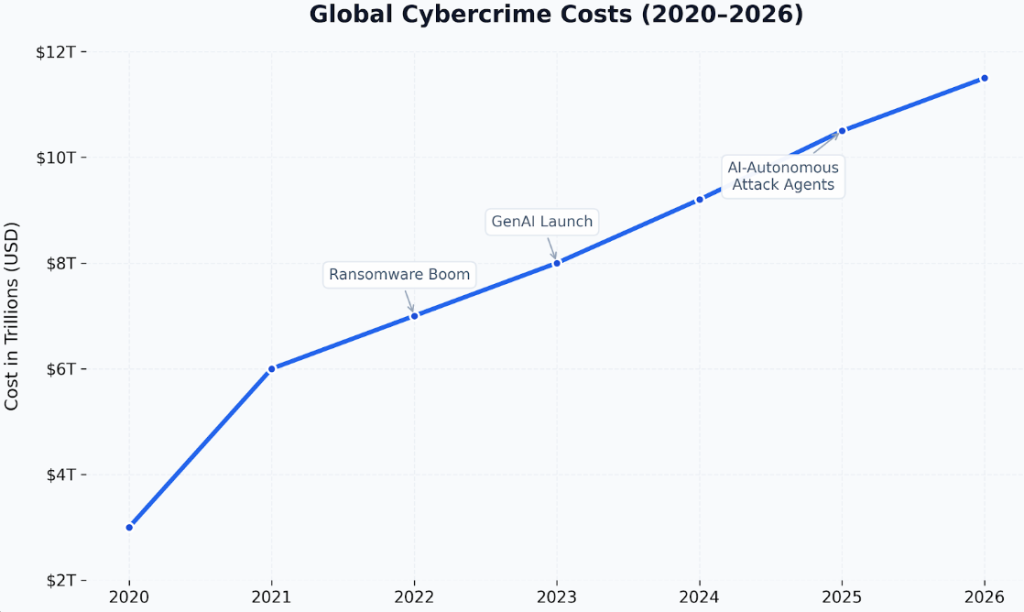
The numbers behind this shift are stark. Global cybercrime costs are forecast to hit $10.5 trillion in 2026. AI-powered attacks specifically surged 72% year over year, with automated scanning now running at 36,000 attack probes per second. Ransomware hits a new target every 2 seconds. Supply chain compromises have nearly quadrupled since 2020. None of this is a coincidence. A specific set of forces converged around 2023 and 2024 and the consequences are showing up in every threat intelligence report published this year.
AI Has Made Expert-Level Attacks Accessible to Anyone
The most significant structural change in cybersecurity in the last three years is not that attacks got more sophisticated. It is that sophisticated attacks got cheap. Before generative AI, crafting a convincing phishing email in perfect English, with contextually appropriate details about the target’s company and role, required either a skilled operator or significant time investment. Now it takes a few prompts. Related reading: Why Ethical Hackers Are the Unsung Heroes of Cybersecurity.
AI-generated phishing lures have increased click-through rates by up to 54% compared to traditional approaches, according to 2026 cybersecurity research. The obvious tells that trained users watch for, such as bad grammar, awkward phrasing, and generic greetings, have been completely eliminated. Phishing now accounts for 42% of all global breaches and AI has made every individual attack more convincing while reducing the cost of running thousands of them simultaneously to near zero. Read next: Cybersecurity.
The same applies to malware. Polymorphic malware that rewrites its own code using AI evasion logic now represents 22% of advanced persistent threats. Self-mutating phishing kits are used by 1 in 5 phishing groups. In 2020, creating malware that could evade antivirus detection required deep technical expertise. In 2026, it requires access to the right dark web tool or a jailbroken language model.
The attack surface has also expanded in proportion to AI adoption itself. Every new AI integration, every LLM API endpoint, every agentic workflow that connects to enterprise systems is a new potential entry point. 1 in 8 AI-related breaches in 2026 involves autonomous agent exploitation, a category that barely existed as a threat vector 18 months ago.
Supply Chain Attacks Have Become the Preferred Entry Point
IBM X-Force identified a nearly 4x increase in large supply chain and third-party compromises since 2020. The reason is straightforward: it is easier to breach a trusted vendor who has access to 50 organizations than to breach each of those 50 organizations directly. An attacker who compromises a CI/CD tool, an open-source dependency, an identity integration, or a SaaS platform used by thousands of companies has effectively found a master key.
The most recent high-profile example of this logic playing out is the SolarWinds breach pattern, but the 2026 version is faster and more automated. AI tools now crawl public repositories, CI/CD configurations, and SaaS integrations looking for misconfigured access tokens, exposed API keys, and authentication gaps. IBM X-Force observed a 44% increase in attacks that began with exploitation of public-facing applications, largely driven by AI-enabled vulnerability discovery finding basic authentication gaps at scale.
The implication is uncomfortable: an organization can have excellent perimeter security and still be compromised through a vendor it trusts. Third-party risk is no longer a secondary concern in enterprise security planning. In IBM’s data, it is one of the primary entry vectors.
| 💡 The SolarWinds effect at scaleIn 2020, SolarWinds showed that one trusted vendor could expose 18,000 organizations. AI has made the reconnaissance and exploitation required for supply chain attacks available at a fraction of the original cost and skill requirement. The frequency of this attack class has quadrupled as a direct result. |
Deepfakes Turned Social Engineering Into a Precision Weapon
85% of organizations reported experiencing at least one deepfake-related security incident in 2025, according to deepstrike.io’s enterprise security analysis. AI-enhanced social engineering tactics appeared in 29% of data breach investigations in 2025. What was once a fringe attack vector, a blurry video of a CEO, has become a genuine operational threat used to authorize fraudulent wire transfers, extract credentials, and bypass multi-factor authentication through impersonation. Related reading: Ecommerce Fraud Prevention and Data Breach Protection in 2026.
The 2024 Hong Kong finance worker case, where an employee transferred $25 million after a deepfake video call involving AI-generated versions of the company’s CFO and other colleagues, established the playbook. That playbook is now being replicated at scale. Voice cloning from a 30-second audio sample is accessible through commercial tools. Real-time face swapping runs on consumer hardware. The barriers to executing a convincing deepfake attack are essentially gone.
What makes deepfake social engineering particularly effective is that it attacks the human layer of security that technical controls cannot fully protect. An employee who receives what looks and sounds like a video call from their IT director asking them to approve an urgent access request is facing a situation that MFA alone cannot defend against.
The Major Attack Categories and What Changed in Each
| Attack Type | How AI Changed It | 2026 Scale |
|---|---|---|
| Phishing | AI generates personalized lures with no grammar errors; click-through rates up 54% | 42% of all global breaches in 2026 |
| Ransomware | AI-authored ransom notes 40% more effective; deployment automated end-to-end | Attack every 2 seconds; $74 billion in damage costs |
| Supply Chain Attacks | AI finds trusted integration weak points across CI/CD, SaaS, and vendor networks | Nearly 4x increase since 2020 per IBM X-Force 2026 |
| Deepfake Social Engineering | Real-time AI voice and video impersonation of executives, IT staff, vendors | 85% of organizations faced deepfake incidents in 2025 |
| Vulnerability Exploitation | AI scans 36,000 applications per second to find auth gaps and unpatched CVEs | 40% of IBM X-Force 2025 incidents; 44% more app attacks in 2026 |
| AI Agent Attacks | Autonomous AI agents execute multi-step breaches without human operators | 1 in 8 AI breaches involve autonomous agents; 89% YoY growth |
The Uncomfortable Truth: Basic Security Gaps Are Still Everywhere
Everything above makes it sound like the threat landscape has become impossibly sophisticated. That is partially true. But the IBM X-Force finding that deserves the most attention is not about AI. It is this: cybercriminals are still exploiting basic security gaps at dramatically higher rates in 2026. Not because those gaps are new. Because they have always been there and AI has simply made finding them fast and cheap.
44% of attacks that IBM X-Force observed in 2026 began with the exploitation of public-facing applications with missing authentication controls. Not zero-day vulnerabilities. Not sophisticated AI agents. Missing authentication controls. The kind of gap that a security audit in 2019 would have flagged and that still exists because the organization never got around to fixing it.
Vulnerability exploitation became the leading cause of attacks overall, accounting for 40% of incidents. Most of those vulnerabilities are not new discoveries. They are known CVEs that organizations have not patched, because patching is expensive and disruptive and the risk felt manageable until an AI tool started scanning for it at 36,000 probes per second.
The cybersecurity industry has a convenient narrative that threats are getting more sophisticated and therefore harder to defend against. That is true. It is also true that an enormous share of successful breaches in 2026 still exploit gaps that defenders have known about for years and simply have not closed. AI has not made attackers smarter. It has made them faster, and faster has exposed how much deferred security work is sitting in enterprise backlogs everywhere.
Ransomware Has Become an Industry With Professional Infrastructure
Active ransomware and extortion groups surged 49% year over year according to IBM X-Force 2026, even as publicly disclosed victim counts rose a comparatively modest 12%. The discrepancy between group growth and public disclosure suggests that a significant portion of ransomware payments are being made quietly to avoid reputational damage, which in turn funds the growth of more groups.
Ransomware as a Service (RaaS) has professionalized the economics of extortion to the point where technical skill is largely optional. Criminal groups sell access to ransomware tools, infrastructure, and even customer support for victims negotiating payment. The people executing the attacks do not need to understand how the encryption works. They just need to deploy it and wait.
Ransomware damage costs in 2026 are forecast at $74 billion. Healthcare saw a 76% rise in targeted AI attacks in 2025, largely driven by the combination of valuable patient data, historically underfunded security, and the life-critical nature of operations that makes paying ransoms rational from a hospital administrator’s perspective. Education, government, and financial services all saw similar acceleration.
What This Tells Us
The most honest way to read the 2026 cyber threat data is this: the threat environment got harder for defenders not because attackers got genius-level smarter, but because AI gave them industrial-scale efficiency. The same gaps that existed in 2019 are still being exploited, but now thousands of them can be probed simultaneously in seconds. The same social engineering tactics that required skilled operators now run on commodity tools. The same ransomware business model now operates at professional scale with customer support.
The organizations that are holding the line in 2026 are not doing anything exotic. They closed the known gaps, implemented MFA everywhere, invested in supply chain risk programs, and built AI-powered detection tools that operate at the same speed as AI-powered attack tools. The defenders who are struggling are the ones who deferred the foundational work because the threat felt manageable.
The threat is no longer manageable through deferral. That is the straightforward message in every threat intelligence report published this year.