
There’s a quiet shift happening across ecommerce right now, and most businesses haven’t noticed it yet.
Shoppers are no longer always the ones doing the shopping. AI agents are.
In 2026, a growing number of online purchases are being researched, compared, and completed not by a human clicking through product pages, but by AI agents acting on a person’s behalf. You tell an agent, “Get me the best noise-canceling headphones under $150 that ship by Friday,” and the agent handles everything else: browsing, comparing, checking inventory, applying discounts, and checking out.
This is agentic ecommerce. And it’s not a future concept, it’s actively reshaping how online retail works right now.
If you run an ecommerce business or are building one, understanding this shift isn’t optional. Here’s what you need to know.
What Is Agentic Ecommerce?
Agentic ecommerce is a model where AI agents autonomously handle shopping tasks on behalf of consumers or businesses, from product discovery all the way through checkout and post-purchase support.
The key word is autonomous. We’re not talking about chatbots that answer questions or recommendation widgets that suggest products. Agentic AI actually does things. It reasons through a goal, queries systems, evaluates options, and takes action, without needing a human to walk it through every step.
Think of it this way: traditional ecommerce is a storefront you have to walk through yourself. Agentic ecommerce sends a smart assistant to do the shopping for you.
The clearest definition: Agentic commerce is when AI stops assisting and starts executing.
Why 2026 Is the Breakout Year for Agentic Ecommerce?
This isn’t hype. Several forces converged in 2025 and early 2026 to make agentic commerce go from “interesting experiment” to “urgent business priority.”
The numbers make it hard to ignore
AI-driven visits to U.S. retail sites increased 393% year-over-year in Q1 2026, according to Adobe Digital Insights, and those AI-referred shoppers converted 42% better than non-AI visitors. Meanwhile, a 2026 IBM Institute for Business Value study found that 45% of consumers already use AI for some part of the buying journey.
McKinsey projects the global agentic commerce opportunity at $3–5 trillion by 2030.
The infrastructure is now real
Google launched its Universal Commerce Protocol (UCP) in January 2026, co-developed with Shopify, Target, Wayfair, and backed by Home Depot, Lowe’s, Best Buy, Visa, and Mastercard. OpenAI’s Instant Checkout went live via its Agent Commerce Protocol (ACP) in late 2025. Shopify made agentic storefronts available to millions of merchants in March 2026, letting products be discovered and purchased directly inside ChatGPT and other AI platforms.
Consumer readiness is there
70% of shoppers say they’re at least somewhat comfortable with an AI agent making purchases on their behalf. Among Gen Z and millennials, 84% say they’re likely to use AI when making purchases.
The ecosystem, protocols, infrastructure, consumer willingness, and AI capability, has finally aligned.

Agentic Ecommerce vs. Traditional Automation vs. Basic Chatbots
This distinction matters because everyone is calling their tools “agentic” in 2026. Most of them aren’t.
| Capability | Rule-Based Bot | AI Chatbot | Agentic AI |
| Follows scripts | ✅ | ❌ | ❌ |
| Answers questions | ✅ | ✅ | ✅ |
| Multi-step reasoning | ❌ | Limited | ✅ |
| Acts across systems | ❌ | ❌ | ✅ |
| Executes transactions | ❌ | ❌ | ✅ |
| Adapts without prompting | ❌ | ❌ | ✅ |
A truly agentic platform needs four things: system access (read and write), autonomous reasoning (not a decision tree), multi-step execution, and the ability to recover when things go sideways. If you have to manually build a workflow for every scenario, it’s automation, not agency.
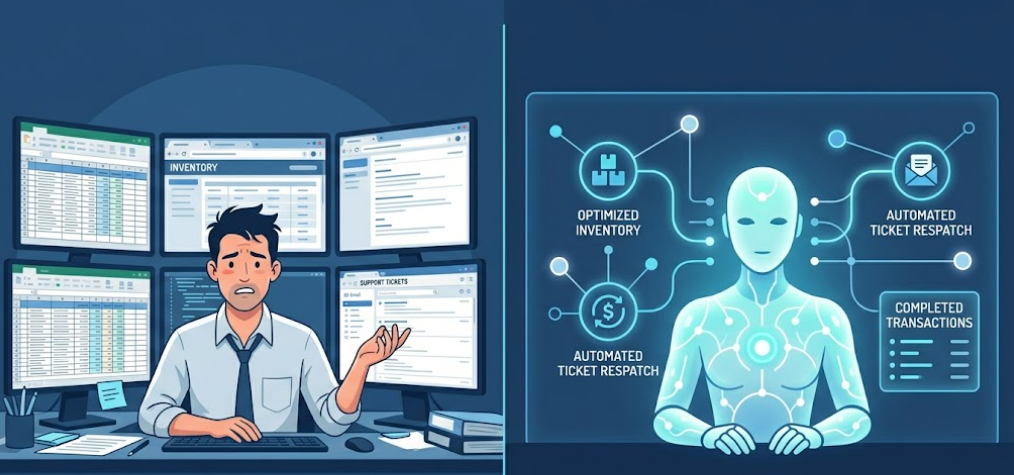
How AI Agents Are Replacing Ecommerce Workflows Right Now
This is where the impact gets concrete. Here are the workflows AI agents are actively taking over in 2026:
1. Product Discovery and Personalization
Instead of static product pages, agents query catalog data, read customer history, analyze behavioral signals, and surface exactly the right products, in real time. Personalization has shifted from “based on what you bought before” to intervention-based, responding to live signals like hesitation patterns, scrolling behavior, and cart composition.
2. Cart Building and Checkout
Agents don’t wait for shoppers to build carts manually. They generate complete carts based on a user’s stated goal, check availability, substitute out-of-stock items, apply relevant coupons, and guide to checkout, all in one conversation.
Google’s AI Mode now includes a “Buy for me” button for selected US retailers. Shopify merchants’ products are automatically purchasable inside ChatGPT. This is zero-click commerce becoming real.
3. Customer Support at Scale
AI agents handle the full resolution cycle, not just answering “where’s my order?” but actually pulling live data from shipping systems, processing refunds, managing returns, updating subscriptions, and closing tickets without any human involvement. In advanced deployments, agents handle up to 90% of L1 support queries with 100% policy accuracy.
4. Inventory and Pricing Intelligence
Agentic systems monitor demand in real-time, adjust pricing dynamically based on competitor data, and trigger replenishment before stockouts happen. This replaces what used to require a combination of a pricing analyst, an inventory manager, and a business intelligence tool.
5. B2B Order Workflows
B2B is arguably where agentic commerce has the most immediate impact. Agents automate multi-step processes: generating quotes, managing approvals, handling negotiations, processing recurring orders, and checking compliance, tasks that previously required hours of manual coordination. Forrester predicts that 90% of B2B buying will be AI agent-intermediated by 2028.
What Agentic Ecommerce Means for Your Tech Stack
Here’s the part most brands are underestimating: agentic commerce doesn’t just change your front-end shopping experience. It changes your entire technical foundation.
Your product data needs to be machine-readable:
AI agents can only recommend and sell products they can understand. That means structured data, enriched metadata, schema markup, clean catalogs, and consistent product feeds. If your data is messy, AI agents skip you.
Your systems need to be connected:
Agents operate across your catalog, OMS, CRM, PIM, payment gateways, and shipping systems simultaneously. Siloed systems mean incomplete agent actions, or failed ones.
You need to prepare for two types of customers:
Human shoppers and AI agents acting for human shoppers. These require different optimization strategies, different checkout flows, and different data architectures.
Brands that deployed AI capabilities in their stack have already seen measurable separation from competitors, retailers with AI saw 14.2% sales growth vs 6.9% for those without.
The Risks and Real Limits Worth Knowing
Agentic ecommerce is powerful, but it’s not magic. A few honest caveats:
Trust is still a barrier
Only 46% of shoppers fully trust AI recommendations today, and 89% still verify before buying. High-stakes or emotionally-driven purchases, luxury goods, healthcare products, major financial decisions, will still require human judgment for a while.
Identity purchases resist automation
As one Ogilvy strategist put it: “The head will automate quickly; the heart will take longer.” Rational, utilitarian purchases automate well. Aspirational or identity-driven ones are more resistant.
Platform tensions are real
Amazon and some major retailers actively restrict external AI agents on their platforms. The tension between benefiting from AI-driven demand while maintaining control over customer relationships and retail media revenue is an ongoing tug of war in the industry.
Security needs serious investment
Agents that can transact autonomously also create new fraud vectors. Your agentic stack needs built-in guardrails, fraud detection, and agent verification layers from day one.
How to Get Started With Agentic Commerce in 2026
You don’t need to rebuild everything overnight. The smartest approach is a conversion-focused MVP that delivers immediate value while building toward a fully agentic stack.
A practical roadmap:
- Audit your product data, make it structured, machine-readable, and catalog-ready for AI platforms
- Start with a focused agent, an AI shopping assistant, a smart support agent, or an autonomous replenishment tool
- Connect your core systems, your agent needs read/write access to catalog, OMS, and CRM at minimum
- Enable agentic storefronts, if you’re on Shopify or compatible platforms, activate AI channel distribution
- Optimize for AEO, structure your content so AI overviews and LLM summaries can accurately surface your products
- Scale with orchestration, once your first agent is working, add multi-agent coordination across pricing, inventory, and marketing
Full enterprise-scale agentic systems, with multi-agent workflows, ERP integration, and advanced governance, can take 6–12 months to build properly. That’s why starting now matters.
The Bottom Line: Agentic Commerce Isn’t Coming, It’s Here
Every major platform, Google, Shopify, OpenAI, Salesforce, Visa, has already built infrastructure for agentic commerce. The brands winning in 2026 aren’t the ones debating whether to adopt AI. They’re the ones that have already embedded agents into their discovery, conversion, and operations workflows.
The shift from reactive AI to autonomous AI agents is the most significant structural change in ecommerce since mobile. And like mobile, the brands that moved early are building advantages that are genuinely hard to close later.
Your customers are already using AI to shop. The question is whether your store is ready to be found, understood, and purchased through those agents.