
Supply Chain Systems Built for What's Actually Happening, Not What Happened Yesterday
From supplier visibility to warehouse coordination, we build logistics software that shows you real-time reality — not a status update that was already stale by the time it arrived.
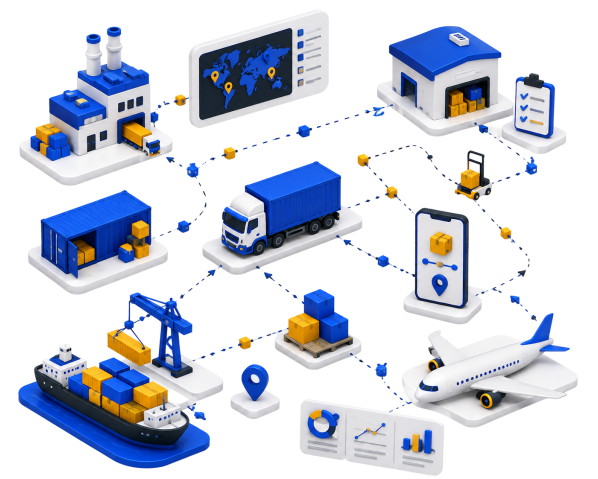
Architecture Layer · Reliability + Integration-led
Stale data is the actual supply chain problem
A shipment delay you find out about after the customer complains isn't a communication gap — it's a system that never actually knew where anything was in real time. A disruption you can't see coming isn't bad luck — most supply chain leaders say the same thing: they're managing surprises, not predicting them, because the underlying data is too slow to act on.
And a warehouse system that doesn't talk to your supplier's system isn't a minor integration gap — it's the reason nobody trusts the numbers on either side.
Most supply chain data still moves in batches and periodic updates. By the time a problem shows up in a report, it's already too late to act on it cheaply.
Most supply chain leaders say managing disruptions as they happen is harder than seeing them coming — because the visibility to predict often isn't there yet.
A warehouse system and a supplier system that don't share real data create manual reconciliation work and decisions made on guesses, not facts.
Supply Chain Engineering Across the Full Stack
From the checkout your customers see to the inventory and deployment systems they never do.
 01
01
Real-Time Visibility Platforms
Systems that surface where shipments and inventory actually are right now, not a periodic batch update.
 02
02
Supplier & Partner Integration
Connecting systems across supplier, carrier, and warehouse boundaries so everyone's working from the same real numbers.
 03
03
Disruption Detection & Alerting
Flagging a problem while there's still time to act on it cheaply, not after it's already cost something.
 04
04
Warehouse & Fulfillment Systems
Coordination systems built for how a real warehouse actually operates, not a theoretical workflow.
 05
05
Legacy System Modernization
Phased migration for logistics systems that can't afford a shipment to get lost mid-transition.
 06
06
Secure Cloud & Deployment
Deployment pipelines with security built into every release, on infrastructure architected by a certified Microsoft Gold Partner team.
Visibility Mapped First. Integration Designed Second. Prediction Layered Third.
Most supply chain projects try to add prediction on top of data that's already stale. We fix the visibility problem first, because a forecast built on old data isn't a forecast — it's a guess with better formatting.
Visibility gap assessment
We map where your current data goes stale — which systems update in real time, which update in batches, and where that gap actually costs you.
Integration architecture
We connect supplier, carrier, and warehouse systems so data moves in real time across the boundaries that matter most.
Build & validate
Systems tested against your real operational patterns, not a clean demo scenario.
Launch & ongoing monitoring
Active monitoring so a new visibility gap gets caught early, not after it's already caused a disruption.


Trusted by enterprise leaders
What decision-makers say about working with Techverx.



We worked with Techverx on the development of an application. Their team took on the task as though it was being developed for themselves. Their expertise, support and contributions were very key to the success. Techverx continues to be involved in further development for our company. I highly recommend their services.
 Director Information Technology — Postal Methods

We reached out to Techverx in March 2019 and asked them to provide us with a proof of concept for a new subsystem that we were building. They rose to challenge and delivered a great POC in the four week timeframe. Since, that time Techverx has been a great partner for us. They are an integral part of both our architecture and development teams.
 Head of Engineering — Lightpoint

Working with Techverx has been a great collaboration is more than an understatement. They are engaging, interactive and futuristic. The inhouse support is always there around the clock to keep us updated about the process.
 Head of Product Management — Drive

Techverx got us from a stuck pilot to a governed production system in a single quarter — they understood compliance as well as engineering.
Tired of finding out about problems after they've already cost you?
Tell us what you're working with, and we'll give you an honest read on where your real visibility gaps are.