
Retail Systems Built to Survive Your Busiest Day, Not Just an Average One
From checkout infrastructure to inventory systems, we build retail software that holds up when traffic spikes 100x — not systems that hopefully hold.
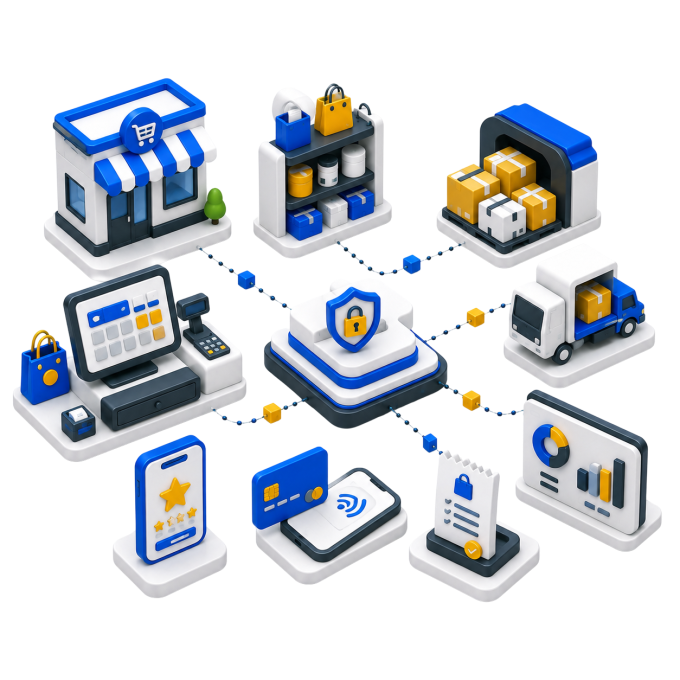
Architecture Layer · Reliability + Integration-led
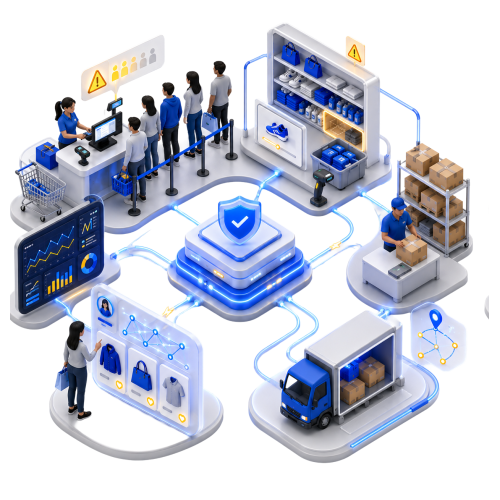
Retail software has to work under real pressure
A checkout that crashes on your busiest shopping day of the year isn't a bad afternoon — it's the one day your revenue depended on, gone. An inventory system that shows a product in stock when it isn't isn't a minor glitch — it's a customer who ordered something you can't deliver, and won't order from you again.
And a personalization engine nobody on the current team fully understands isn't a quirky legacy system — it's a feature frozen in place because touching it feels too risky. Retail software has to work under real pressure, not just in a quiet testing environment.
Peak shopping days bring traffic multiples of a normal day, on a schedule you already know. A system that "probably holds" isn't good enough when the spike is guaranteed to come.
A stock count that's out of sync across channels doesn't just look bad — it breaks a promise to the customer the moment they check out.
A tool that fits the real workflow is one clinicians keep using.
Retail Engineering Across the Full Stack
From the checkout your customers see to the inventory and deployment systems they never do.
 01
01
Checkout & Payment Infrastructure
Systems built to handle peak traffic multiples without degrading, tested against real load, not synthetic benchmarks.
 02
02
Inventory & Omnichannel Systems
Real-time stock visibility across in-store, e-commerce, and warehouse — not a nightly sync that's already stale by morning.
 03
03
Personalization & Recommendation Engines
Built to be understood and safely changed by the next engineer, not a black box the team is afraid to touch.
 04
04
Peak-Season Load Testing
Infrastructure stress-tested against your actual traffic patterns before the season that matters, not after it exposes a gap.
 05
05
Legacy Platform Modernization
Phased, reversible migration for retail systems that can't afford a broken launch day.
 06
06
Secure Cloud & Deployment
Deployment pipelines with security built into every release, running on infrastructure architected by a certified Microsoft Gold Partner team.
Scalability Proven First. Systems Integrated Second. Launch Third
Most retail projects get the order backwards — building features first and hoping the infrastructure holds later. We prove scalability before anything ships.
Load & traffic scoping
We map your actual peak traffic patterns — historical spikes, seasonal events — before deciding what the architecture needs to handle.
Architecture & integration design
Checkout, inventory, and personalization systems designed to work together under real load, not integrated as an afterthought.
Stress testing & validation
Every system tested against real traffic multiples before launch, not discovered live on your busiest day.
Launch & peak-season monitoring
Active monitoring through your actual peak period, not just the initial rollout window.


Trusted by enterprise leaders
What decision-makers say about working with Techverx.



We worked with Techverx on the development of an application. Their team took on the task as though it was being developed for themselves. Their expertise, support and contributions were very key to the success. Techverx continues to be involved in further development for our company. I highly recommend their services.
 Director Information Technology — Postal Methods

We reached out to Techverx in March 2019 and asked them to provide us with a proof of concept for a new subsystem that we were building. They rose to challenge and delivered a great POC in the four week timeframe. Since, that time Techverx has been a great partner for us. They are an integral part of both our architecture and development teams.
 Head of Engineering — Lightpoint

Working with Techverx has been a great collaboration is more than an understatement. They are engaging, interactive and futuristic. The inhouse support is always there around the clock to keep us updated about the process.
 Head of Product Management — Drive

Techverx got us from a stuck pilot to a governed production system in a single quarter — they understood compliance as well as engineering.
Ready for your next big traffic day?
Tell us what you're running on, and we'll give you an honest read on whether it holds.