
Healthcare Technology That Protects Patients and Earns Clinician Trust
From AI-powered patient scheduling to EHR-integrated clinical systems, we build healthcare software that holds up under compliance scrutiny and actually gets used by the people relying on it every day.

Architecture Layer · Reliability + Integration-led
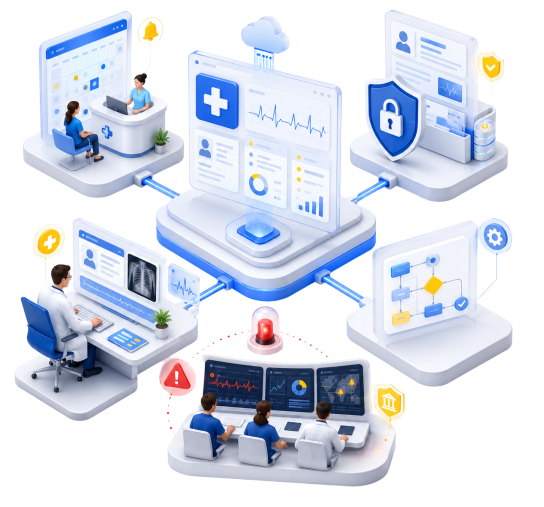
Healthcare software doesn't get to fail softly
A booking system that drops an appointment isn't a UX bug — it's a patient who couldn't get seen. A data leak in a clinical system isn't just a security incident — it's a compliance violation with real legal consequences, for the provider and for the patient whose record was exposed.
And a clinical tool that clinicians quietly stop using isn't a training problem — it's what happens when nobody sat down and watched how the workflow actually happens on the floor before writing code.
Encryption, access control, audit logging — the minimum, not add-ons.
Integration experience with platforms never built for modern APIs.
A tool that fits the real workflow is one clinicians keep using.
Healthcare Engineering Across the Clinical and Administrative Stack
From patient-facing tools to the back-office systems clinicians depend on without ever seeing.
 01
01
AI Voice & Booking
Agents
24/7 scheduling agents that understand natural speech and integrate with existing calendar and records systems, operating fully within compliance boundaries.
 02
02
Clinical System
Integration
Custom integration layers connecting new tools to existing clinical platforms and insurance systems — without disrupting the workflows already running on top of them.
 03
03
Patient Portals &
Care Apps
Appointment management, health record access, and telehealth applications built for accessibility and compliance at once, not one traded off for the other.
 04
04
Clinical Decision
Support
AI-assisted tools with human checkpoints on anything irreversible, engineered so a failure is caught before it reaches a patient interaction.
 05
05
Analytics &
Reporting
Performance dashboards and population-health tools built for the people making real operational decisions, not a generic reporting template.
 06
06
Compliant Cloud &
Deployment
Deployment pipelines with security enforced at every stage and full audit trails, running on infrastructure built by a certified Microsoft Gold Partner team.
Compliance Scoped First. Clinical Workflow Mapped Second. Engineering Starts Third.
Healthcare software built without workflow mapping fails at adoption. Built without compliance scoping, it fails at deployment. We don't let either happen by skipping the step that prevents it.
Compliance scoping
We map every relevant compliance obligation before a single architecture decision gets made — not as a checkbox at the end.
Workflow discovery
We sit with the people who'll actually use this — where the friction already is, what workaround they've built to cope with it, and what a new system has to do differently to earn real adoption.
Architecture & integration
Compliance controls and integration patterns get built into the architecture itself, with performance requirements set to real clinical workflow standards.
Build & clinical validation
Real clinicians test the workflow before launch. A compliance review confirms every requirement is met before the system ever touches patient data.


Trusted by enterprise leaders
What decision-makers say about working with Techverx.



We worked with Techverx on the development of an application. Their team took on the task as though it was being developed for themselves. Their expertise, support and contributions were very key to the success. Techverx continues to be involved in further development for our company. I highly recommend their services.
 Director Information Technology — Postal Methods

We reached out to Techverx in March 2019 and asked them to provide us with a proof of concept for a new subsystem that we were building. They rose to challenge and delivered a great POC in the four week timeframe. Since, that time Techverx has been a great partner for us. They are an integral part of both our architecture and development teams.
 Head of Engineering — Lightpoint

Working with Techverx has been a great collaboration is more than an understatement. They are engaging, interactive and futuristic. The inhouse support is always there around the clock to keep us updated about the process.
 Head of Product Management — Drive

Techverx got us from a stuck pilot to a governed production system in a single quarter — they understood compliance as well as engineering.
Building healthcare technology that clinicians and patients can actually trust?
Tell us what you're working with, and we'll come back with a compliance scope, an integration assessment, and an honest read on what it actually takes.