
Legal Technology Built Around What Can Never Be Exposed
From document management to case workflow systems, we build software for firms and legal departments where confidentiality isn't a feature — it's the entire business.
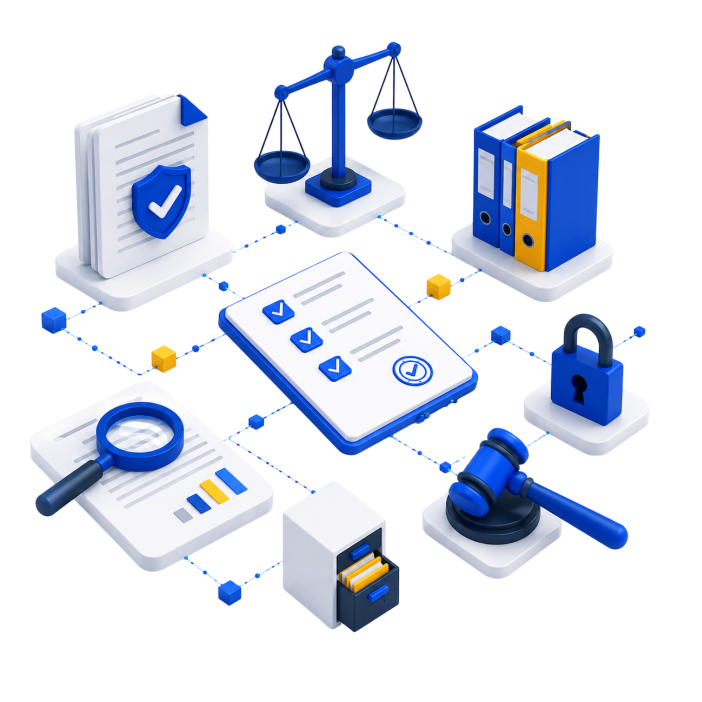
Architecture Layer · Reliability + Integration-led
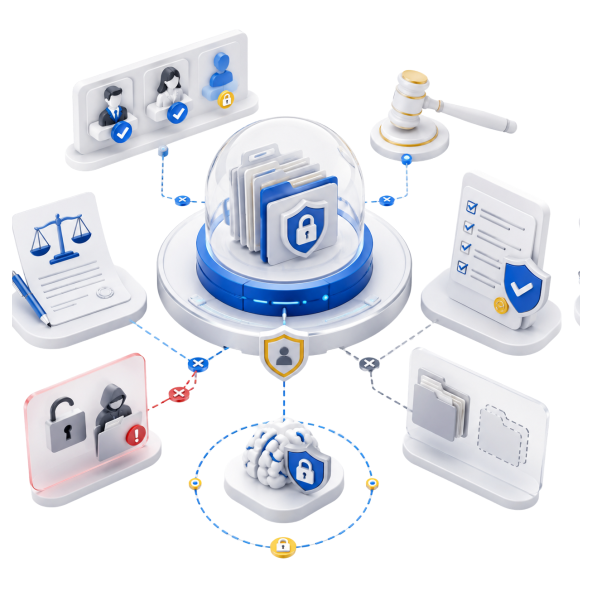
Confidentiality is the whole design constraint
A confidentiality breach in legal software isn't like any other incident — it can waive privilege entirely, turning a technical problem into a case-losing one. A document workflow that doesn't match how lawyers actually work isn't a mild inconvenience — it gets quietly abandoned for email and shared drives, the exact behavior the system was supposed to replace.
And an AI feature added without understanding how it handles data isn't innovation — it's a risk most firms haven't fully mapped yet.
A data exposure in legal software risks more than embarrassment — it can compromise privilege and directly affect a client's case.
Legal teams will route around software that doesn't match how they actually work, quietly reverting to email and shared drives.
Using the wrong AI tool with unclear data handling can create exposure most firms haven't fully thought through yet — the architecture question matters here more than almost anywhere else.
Legal Engineering Across the Full Stack
From case and document systems to the AI, migration and deployment work around them.
 01
01
Document & Case
Management
Systems built around how legal teams actually organize and access case information, not a generic file-sharing tool.
 02
02
Confidentiality-First
Architecture
Access controls and data handling designed specifically around privilege and confidentiality risk, not generic data security.
 03
03
E-Discovery & Compliance
Workflows
Systems built for the specific accuracy and audit demands legal work demands.
 04
04
Secure AI
Integration
AI features implemented with clear, defensible data handling — because the wrong implementation creates real risk here.
 05
05
Legacy System
Modernization
Phased migration for legal systems that can't afford a confidentiality gap during transition.
 06
06
Secure Cloud &
Deployment
Deployment pipelines with security built into every release, on infrastructure architected by a certified Microsoft Gold Partner team.
Confidentiality Mapped First. Workflow Matched Second. Engineering Third.
Most legal tech projects treat confidentiality as a security checklist and workflow fit as an afterthought. We treat both as the actual foundation of the system.
Confidentiality & risk mapping
We map exactly what can never be exposed and what privilege risk actually looks like for your specific practice, before any architecture decision.
Workflow discovery
We study how your team actually works today — including the workarounds — so the new system fits instead of getting quietly abandoned.
Build & validate
Every access boundary and data flow tested against the confidentiality requirements mapped at the start.
Launch & ongoing governance
Active monitoring and access review so confidentiality holds up in daily use, not just at launch.


Trusted by enterprise leaders
What decision-makers say about working with Techverx.



We worked with Techverx on the development of an application. Their team took on the task as though it was being developed for themselves. Their expertise, support and contributions were very key to the success. Techverx continues to be involved in further development for our company. I highly recommend their services.
 Director Information Technology — Postal Methods

We reached out to Techverx in March 2019 and asked them to provide us with a proof of concept for a new subsystem that we were building. They rose to challenge and delivered a great POC in the four week timeframe. Since, that time Techverx has been a great partner for us. They are an integral part of both our architecture and development teams.
 Head of Engineering — Lightpoint

Working with Techverx has been a great collaboration is more than an understatement. They are engaging, interactive and futuristic. The inhouse support is always there around the clock to keep us updated about the process.
 Head of Product Management — Drive

Techverx got us from a stuck pilot to a governed production system in a single quarter — they understood compliance as well as engineering.
Building legal technology that can't afford a confidentiality gap?
Tell us what you're working on, and we'll give you an honest read before you commit to anything.