
Ship Safely, Even On a Friday
Security enforced inline at every deploy stage, and for ML systems, drift detected by comparing production data against a reference distribution — not a one-time launch-day accuracy check.
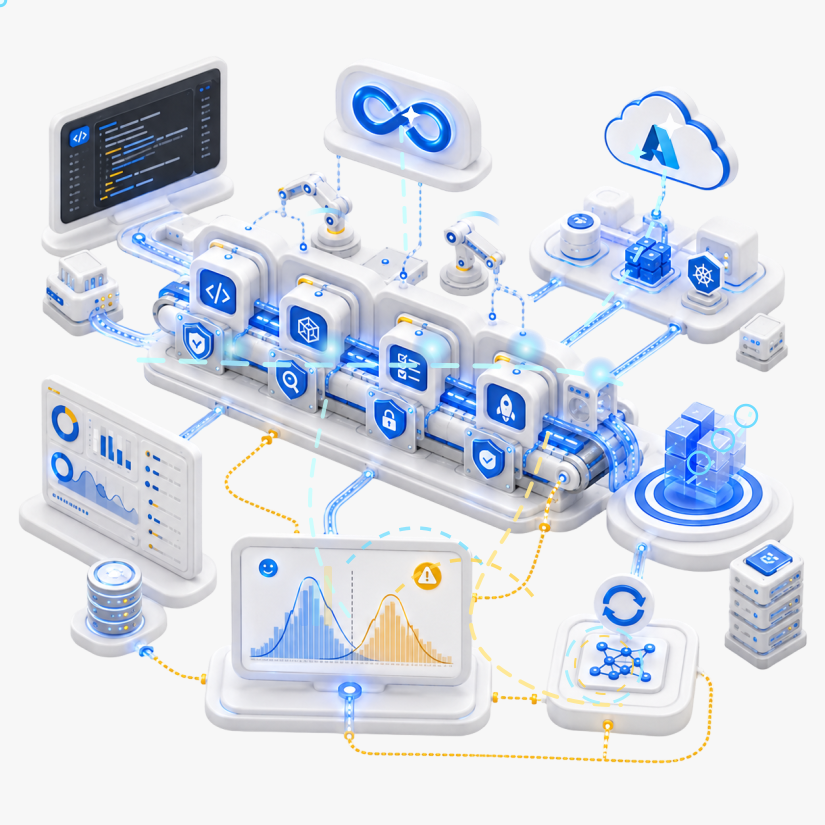
A team afraid to deploy on a Friday is losing velocity every single week, quietly
Security Enforced Inline, Not Reviewed Later
A scan that runs as a separate, slower step is a scan teams learn to route around. We build it into the pipeline itself.
Security Built Into DeliveryA Model's Accuracy Doesn't Stay Fixed
Real-world data drifts. We monitor for it continuously, so a degrading model gets caught before it quietly produces bad output.
Continuous Monitoring MattersConfidence Beyond Our Involvement
We hand off documented, trained, and owned — not a system only we know how to run.
Built for Team IndependenceDelivery Layer
Four gates. Shipping becomes routine because the controls live inside the pipeline.

Audit Gate
Assess current deployment process, security posture, and model monitoring maturity.

Pipeline Gate
CI/CD automation with testing gates, so shipping is routine, not high-risk.

Security Gate
Scanning and access controls enforced inside the pipeline itself.

Drift Gate
For ML systems, ongoing distribution-comparison monitoring with automated retraining triggers.
Four disciplines, one pipeline
DevOps
Access, data, and audit boundaries designed in, not patched after review.
SecOps
Headroom proven under real peak load, not estimated on paper.
MLOps
Defined failure behaviour and rollback for every cutover.
Azure Architecture
Code and docs the client’s own team can safely change later.
Where the pipeline carries compliance
Fintech
PCI-DSS compliant pipelines with inline scanning.
Retail
Deployment cadence that holds through peak-season load.
Healthcare
HIPAA-compliant CI/CD with audit trails.
Five steps, in order
Audit current process and monitoring maturity.
Automate the pipeline with testing gates that make shipping routine, not risky.
Secure the pipeline itself, with scanning and access controls enforced inline.
Instrument monitoring and, for ML systems, drift detection with automated triggers.
Hand off a pipeline your own team can run and extend without us.
Frequently asked questions
The most important questions about Techverx and how we help teams move from strategy to production-ready systems.
Deploy With Confidence, Not Fear
We assess your current pipeline, security posture, and model monitoring maturity, then build the controls where they can't be routed around.
Book a Microsoft Cloud Assessment