
What Is Technical Debt? And How Do You Actually Pay It Off?

What Is Technical Debt? What does it mean by "Tech Debt"?
Every engineering team knows the feeling. A feature that should take two days takes two weeks. A simple bug fix breaks three other things. Adding a new integration feels like defusing a bomb in the dark. The codebase that powered your early growth is now the biggest thing slowing you down.
That is technical debt. And it is costing businesses a staggering $2.41 trillion every single year in the US alone, according to Accenture, with $1.52 trillion needed just to fix the backlog that already exists. A September 2025 CAST report analyzing more than 10 billion lines of code across 47,000 applications found that global technical debt has now reached 61 billion workdays of repair time. Even if every one of the world’s 25 million developers dropped everything and worked exclusively on clearing that backlog, it would still take nine years.
And it is getting worse. Accenture’s December 2025 Digital Core research found that generative AI has become the single highest contributor to new technical debt, tied with enterprise applications, as companies rush to deploy AI without the governance and architecture to support it sustainably.
So what exactly is technical debt, how does it compound, and how do you actually start paying it down without stopping everything else? This article answers all of it, clearly and practically.
What Is Technical Debt, Really?
The term was coined by software engineer Ward Cunningham in 1992. He described it as the implied cost of rework caused by choosing an easy, short-term solution instead of the better, longer-term approach. Just like financial debt, it is not inherently evil. Sometimes taking on a small amount of debt to ship fast is exactly the right call. The problem is when it compounds unmanaged and starts charging interest.
In plain language: every time a developer writes a quick workaround instead of the proper solution, skips writing tests because the deadline is tomorrow, copies and pastes code instead of building a reusable function, or ships without documentation, they are borrowing time from their future selves. And like any loan, it has to be paid back eventually, often at a much higher cost than the original shortcut saved.
McKinsey research found that technical debt accounts for up to 40% of the entire technology estate in the average enterprise. That means nearly half of what most companies own in software and infrastructure is already working against them.
The contrast is stark. Retailers are pouring capital into AI and the market opportunity is enormous, yet the vast majority of AI initiatives are dying before they deliver a dollar of return. Meanwhile, BCG research shows AI leaders are achieving 1.5x higher revenue growth and 1.6x greater shareholder returns compared to laggards. The gap between companies that get AI into production and those stuck in pilot mode is widening every quarter.
The 7 Types of Technical Debt to Know in 2026
Technical debt is not one thing. It lives in different layers of your stack and each type compounds differently. Here is what to watch for, including a newer category that barely existed on anyone’s radar two years ago.
Type | Common Cause | Business Impact |
Code Debt | Quick fixes, skipped reviews | Slower development, more bugs |
Architecture Debt | Poor early design decisions | Hard to scale, brittle integrations (80% of all debt by 2026, Gartner) |
Infrastructure Debt | Aging servers, unpatched systems | Security risk, downtime, rising OpEx |
Documentation Debt | No time allocated for docs | Onboarding bottlenecks, lost institutional knowledge |
Test Debt | Tests skipped to hit deadlines | Regressions, unpredictable releases |
Dependency Debt | Outdated third-party libraries | Security vulnerabilities, compatibility failures |
AI/GenAI Debt | Rapid GenAI adoption without governance | New #1 contributor to enterprise tech debt, Accenture 2025 |
Gartner predicts that by 2026, 80% of all technical debt will be architectural, meaning it will not be something a refactoring sprint can fix. It will require deliberate system redesign. The new entry on this list, AI and GenAI debt, reflects an emerging reality: Accenture’s 2025 survey of 1,500 companies found that executives now rank AI as the top contributor to new tech debt, on par with enterprise applications, as rushed deployments create brittle integrations and undocumented model dependencies across the stack.
How Technical Debt Silently Accumulates
Technical debt rarely builds because engineers are careless. It builds because of pressure: launch deadlines, budget constraints, team turnover, and competing priorities. The patterns that show up most consistently across organizations are these.
Shipping Speed Takes Priority Over Code Quality
This is the most common origin story. Under pressure to deliver, teams cut corners that feel small in the moment. Skip the refactor. Skip the tests. Just get it live. The Stack Overflow Developer Survey found that 62% of developers cite technical debt as their greatest source of frustration at work. Multiplied across hundreds of sprints over several years, those small compromises become a structural problem that requires months, not days, to unwind.
💡 The GenAI Compounding Problem Accenture’s December 2025 research adds a new wrinkle: 52% of organizations plan to increase generative AI spending in 2025–2026. Without architectural governance, every new GenAI deployment is creating a new layer of technical debt faster than most engineering teams can address the existing backlog. |
Teams Grow Faster Than the Architecture
A codebase built for a 5-person startup rarely scales cleanly to a 50-person engineering team. As more developers touch the same code, inconsistencies accumulate. Naming conventions drift. Patterns diverge. What was a deliberate architecture becomes an organic tangle of competing approaches that nobody fully understands anymore.
Legacy Systems That Outlive Their Purpose
Organizations running legacy supply chain or ERP systems typically spend 70 to 80% of their IT budgets on maintenance, leaving only 20 to 30% for innovation. The October 2025 Pegasystems study of more than 500 IT decision makers put a precise dollar figure on this: the average global enterprise wastes $370 million per year due to inability to efficiently modernize legacy systems, with $134 million of that attributed specifically to how long traditional transformation projects take to complete.
If your organization is already feeling this pattern, Techverx’s guide to supply chain technical debt and legacy systems breaks down how it plays out across complex operations and what a realistic modernization timeline looks like.
No Budget Allocated for Debt Repayment
Accenture recommends allocating around 15% of your IT budget specifically to technical debt remediation. Oliver Wyman’s analysis found that only a small minority of companies actually do this. Most treat refactoring as optional, something to get to when things slow down. Things never slow down, and the debt compounds quarterly.
What Ignoring Technical Debt Actually Costs
The numbers are hard to ignore. In the US alone, technical debt costs businesses $2.41 trillion every year and would require $1.52 trillion to fix. Globally, CAST’s 2025 analysis of 47,000 applications across 3,000 companies found the repair backlog has reached 61 billion workdays, a figure that grows larger every quarter as teams ship new code on top of old foundations. Accenture’s research shows that companies carrying lower-than-average technical debt project 5.3% revenue growth between 2024 and 2026, compared to just 4.4% for their higher-debt peers. That gap does not sound dramatic until you run it against the revenue base of a mid-sized enterprise.
The consequences are not always gradual. Technical debt contributed to 13,000 canceled Southwest Airlines flights during the 2022 holiday season and has been linked directly to high-profile security breaches at major enterprises. The longer structural debt is deferred, the more catastrophic the eventual failure mode tends to be.
How to Actually Pay Off Technical Debt
There is no single sprint that makes technical debt disappear. Paying it off requires discipline, prioritization, and organizational buy-in at the leadership level. Here is what consistently works across organizations that successfully close their debt backlog.
1. Audit and Quantify What You Are Carrying
You cannot manage what you cannot measure. Start with a thorough code and architecture audit to map where debt exists, how severe it is, and what it is costing you in developer hours and system reliability. Tools like SonarQube and CodeClimate can surface high-priority issues quickly. For architectural and legacy debt, experienced engineers doing structured assessments often uncover risks that automated tools miss entirely.
Techverx’s IT modernization and infrastructure services include structured technology assessments that help teams map the full scope of their debt before committing to any remediation plan.
2. Budget for Debt Repayment Like the Business Cost It Is
Organizations that consistently outperform their peers allocate around 15% of their IT budget to remediation, not as a one-time catch-up but as a permanent line item. Framing this as an investment in growth rather than a cleanup exercise is what gets CFO buy-in. Accenture’s data shows companies that do this right project revenue growth nearly a full percentage point ahead of peers who do not, which is a compelling board-level number.
3. Prioritize by Business Impact, Not Technical Severity
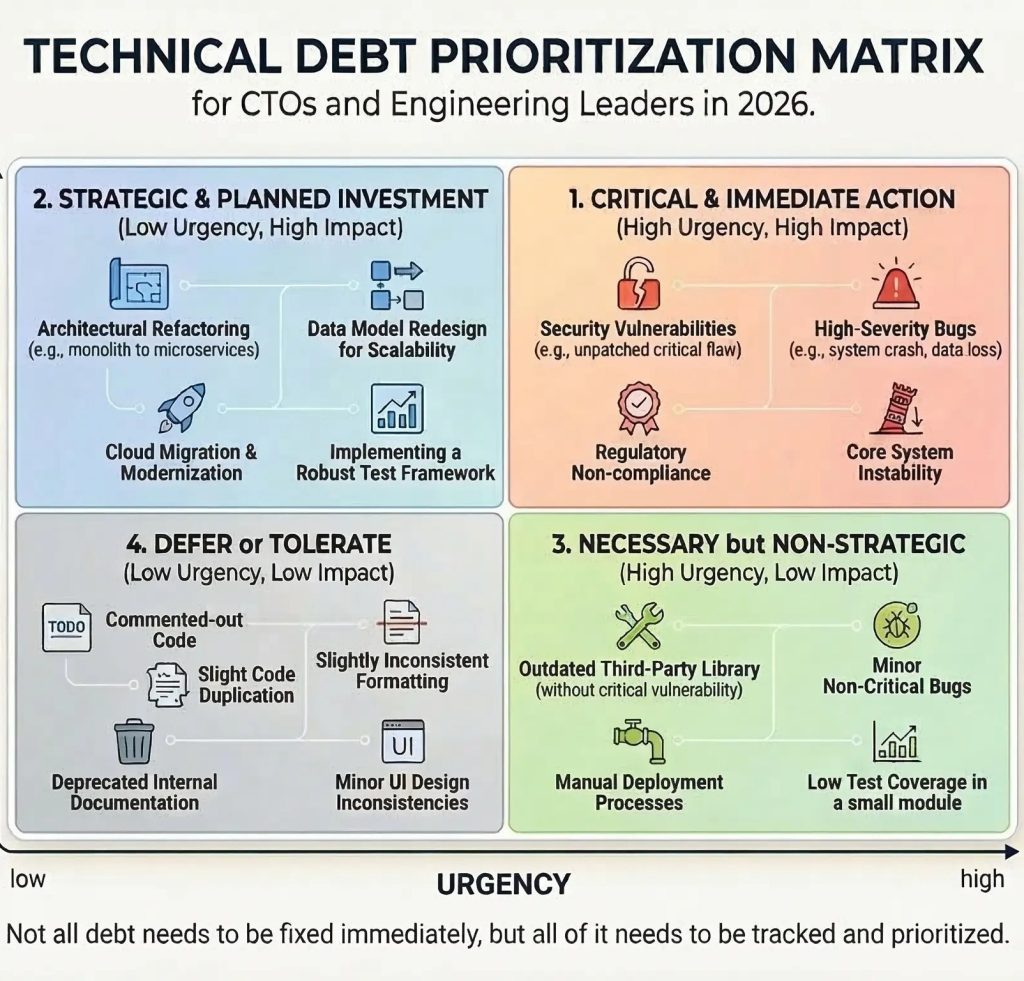
Not all debt needs to be fixed immediately. A messy internal script that runs monthly is very different from fragile architecture in your payment processing pipeline or your inventory sync. Prioritize by risk to revenue, security exposure, and the degree to which the debt is actively blocking new feature development. Low-risk debt can wait. High-risk debt compounds.
4. Refactor Incrementally, Not in a Big-Bang Rewrite
The instinct to rewrite everything from scratch almost always leads to disaster. You end up with two codebases to maintain, a timeline that stretches for years, and a new system that starts accumulating its own debt before the old one is retired. The better approach is continuous, incremental refactoring, improving the areas you are already touching rather than stopping everything for a cleanup sprint that never fully delivers.
5. Modernize Legacy Systems With a Phased Roadmap
For organizations where debt is architectural rather than just code-level, modernization is the only sustainable path. This does not have to mean a full rebuild. Phased migration, strangler fig patterns that wrap legacy systems in modern APIs, and selective re-platforming of the highest-risk components can reduce structural debt dramatically while keeping operations running without disruption.
Techverx specializes in exactly this kind of phased approach. Explore how our legacy system upgrade methodology handles migration, re-platforming, and cloud-native transitions without business continuity risk.
6. Build Systems That Resist Future Debt
The best time to prevent technical debt is before it forms. Enforce code review standards from day one. Invest in automated testing. Use CI/CD pipelines that catch regressions before they reach production. Maintain documentation as a first-class deliverable, not a post-launch afterthought. These practices do not eliminate debt entirely, but they slow its accumulation rate significantly, which is the difference between manageable and structural.
If you are starting a new build or scaling an existing platform, Techverx’s custom software development practice is built around clean architecture, automated testing, and long-term maintainability from the first sprint.
Not Sure Where to Start With Your Technical Debt?
Techverx engineers can audit your codebase and architecture, identify your highest-risk debt, and deliver a prioritized remediation roadmap your team can actually execute.
The Bottom Line
Technical debt is not a code problem. It is a business problem. It slows growth, drains engineering capacity, creates security exposure, and makes it nearly impossible to respond quickly to new opportunities. With global debt now at 61 billion workdays of repair time, and GenAI adding new debt faster than most teams can clear the old kind, the organizations that treat debt management as a strategic priority rather than a cleanup task are the ones pulling decisively ahead.
You do not need to pay it all off at once. You need a clear inventory of what you are carrying, a prioritized plan to tackle the highest-risk debt first, and a budget that makes ongoing remediation part of normal operations rather than a crisis response.
If you are ready to get an honest picture of where your technical debt stands and what it is actually costing you, the engineering team at Techverx is ready to help. Let’s build something that lasts.
FAQs - What is Technical Debt
What is technical debt?
Technical debt is the accumulated cost of shortcuts and compromises made during software development. Like financial debt, small amounts taken deliberately can be fine, the problem is when it compounds unmanaged. Accenture estimates it costs US businesses $2.41 trillion per year.
What are the main types of technical debt?
The most common types are code debt, architecture debt, infrastructure debt, documentation debt, test debt, dependency debt, and, increasingly in 2025–2026, AI/GenAI debt from rushed model deployments. Gartner predicts that by 2026, 80% of all technical debt will be architectural.
How does technical debt slow down a development team?
It makes every task take longer. Developers spend more time understanding fragile code than writing new features. Bug fixes trigger unexpected regressions. Onboarding new engineers takes weeks instead of days. The Stack Overflow Developer Survey found that 62% of developers name it as their top source of frustration at work.
How do you measure technical debt?
Static analysis tools like SonarQube estimate debt in developer-hours. Teams also track it through code complexity scores, test coverage percentages, deployment frequency, mean time to recovery, and the maintenance-to-innovation ratio of their IT budget.
How much of your IT budget should go to fixing technical debt?
Accenture recommends around 15% as a standing allocation. Companies that hit this consistently project revenue growth roughly one percentage point ahead of peers who defer remediation.
Can AI help fix technical debt?
AI tools are becoming genuinely useful for automated code review, refactoring suggestions, and codebase documentation. But Accenture’s 2025 research also found that AI is now the fastest-growing new source of technical debt when deployed without proper governance. It is an accelerator for remediation and a creator of new debt simultaneously.

Hannah Bryant
Hannah Bryant is the Strategic Partnerships Manager at Techverx, where she leads initiatives that strengthen relationships with global clients and partners. With over a decade of experience in SaaS and B2B marketing, she drives integrated go-to-market strategies that enhance brand visibility, foster collaboration, and accelerate business growth.
Hiring engineers?
Reduce hiring costs by up to 70% and shorten your recruitment cycle from 40–50 days with Techverx’s team augmentation services.
Related blogs