
Table Of Content
IT Staff Augmentation vs Traditional Hiring: What Actually Gets Teams Shipping Faster

Your product roadmap has three major releases scheduled this quarter. Two senior engineers just gave notice. Your engineering manager is blocking sprints waiting for approvals on two open headcount requisitions that HR says will take six to eight weeks to close.
That’s not a people problem. That’s a process problem specifically, a hiring process problem that is directly costing you software delivery velocity.
When engineering teams stall, the decision between IT staff augmentation vs traditional hiring isn’t abstract. It’s the difference between shipping on schedule and watching your roadmap slip while competitors move. This blog cuts through the comparison objectively, so you can decide what actually works when speed matters.
The Speed Gap Is Bigger Than You Think
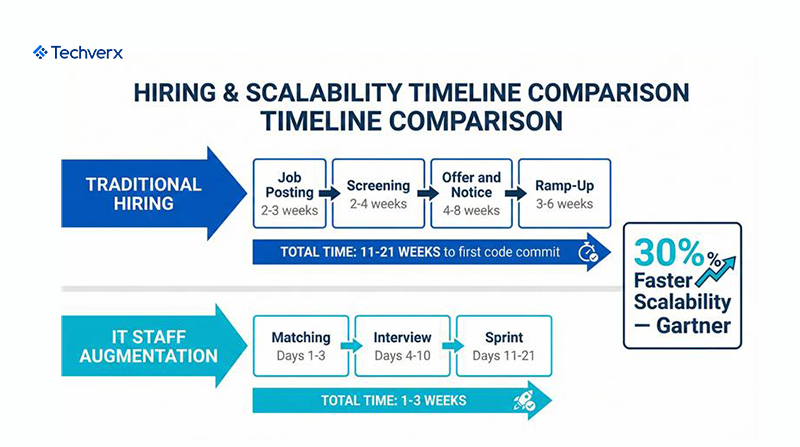
The average time to fill a technical position is 43 days for most IT roles. That’s just time to offer it doesn’t include notice periods, which typically add another 2-4 weeks, or the 3-6 weeks of onboarding and ramp-up before a new hire contributes meaningfully to sprints.
Run the math: traditional hiring vs staff augmentation timelines look like this in practice.
Traditional hiring total timeline: 11-21 weeks before a new developer ships production code.
IT staff augmentation timeline: 1-3 weeks to first code commit, depending on provider and role complexity.
For a team mid-sprint on a critical release, 11-21 weeks isn’t a hiring delay it’s a strategic liability. Software team scaling through traditional pipelines cannot respond to the speed at which engineering demands shift. One departed senior engineer, one surprise customer requirement, one scope expansion, and your quarterly delivery plan is already compromised before HR has posted the job listing.
The Real Cost of Traditional Hiring
Most engineering leaders think about traditional hiring in terms of salary. The full picture is harder to absorb.
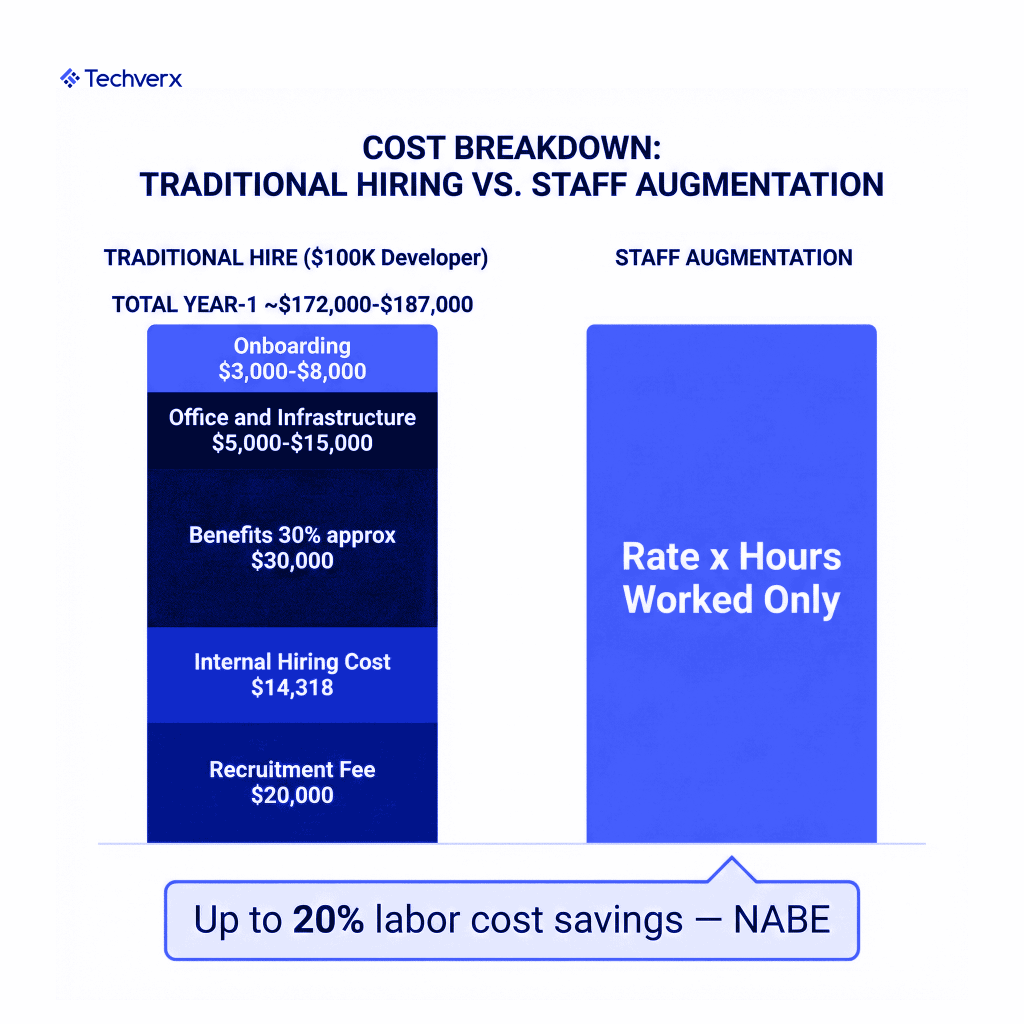
The average cost per hire in 2025 reached $5,200 on average and for some industries such as IT, it reached to $15,000, with technical positions climbing significantly higher due to extended search timelines and talent competition. Recruitment agency fees for IT roles typically range from 15-25% of annual salary meaning $100,000 developer costs $15,000-$25,000 in fees alone before a single line of code is written. Internal hiring processes add further expenses: HR team time, job advertising, technical assessments, and management involvement in interviews accumulate rapidly.
Beyond direct costs, hidden expenses are where traditional hiring vs staff augmentation comparisons get uncomfortable. Project delays, productivity losses from understaffed sprints, missed market windows, and the opportunity cost of engineering managers spending 20-30% of their week on recruitment interviews instead of technical leadership none of these appear on a cost-per-hire report.
The cost of staff augmentation vs hiring looks fundamentally different: you pay agreed-upon rates for actual work performed. No recruitment fees, no benefits overhead, no office infrastructure, no severance exposure if the engagement ends. For project-based or time-sensitive work, the cost structure of IT staff augmentation aligns directly with business outcomes rather than organizational overhead.
What Staff Augmentation Actually Delivers for Engineering Teams
The core advantage of IT staff augmentation for software teams is pre-vetted readiness. Reputable providers maintain active talent pools of engineers who have already completed technical screening. When you engage a staff augmentation provider, you’re selecting from professionals who have been assessed, not starting the evaluation process from scratch.
This pre-vetting changes the delivery equation entirely. A staff augmentation benefits for IT teams framework typically works as follows:
Days 1-3: Requirements scoping and candidate matching against specific stack and domain requirements.
Days 4-10: Technical interviews with your team, selection, and engagement formalization.
Days 11-21: Onboarding, environment access, and first meaningful contributions to the sprint backlog.
Compare that to the 11-21 weeks of a traditional hire, and the compounding delivery advantage becomes clear. According to a Gartner study, organizations using staff augmentation achieve up to 30% faster scalability compared to those relying solely on traditional hiring pipelines. For teams shipping against quarterly roadmaps, that 30% doesn’t translate to a planning metric it translates to whether you hit your release dates.
The Control Question: A Common Objection Addressed
Engineering leaders often resist IT staff augmentation out of concern about losing visibility and control. The objection is understandable but largely misapplied.
Staff augmentation is structurally different from outsourcing. With outsourcing, you delegate project execution to an external team and wait for deliverables. With IT staff augmentation, external professionals join your existing team directly. They attend your standups, work within your sprint cadence, follow your coding standards, use your tools, and report to your engineering managers exactly as a full-time hire would.
You retain 100% control over the development process, architecture decisions, and delivery priorities. The augmented developer is an extension of your team, not a replacement for your process. This distinction matters when evaluating staff augmentation vs hiring for roles requiring close integration with internal systems, domain knowledge, or compliance requirements.
Cost Snapshot: A Concrete Comparison
Cost Item | Traditional Hire ($100K Developer) | Staff Augmentation |
Recruitment Fee (20% avg.) | $20,000 | $0 |
Avg. Internal Hiring Cost | $14,318 | $0 |
Benefits & Insurance (30% est.) | $30,000/year | $0 |
Office & Infrastructure | $5,000–$15,000/year | $0 |
Onboarding / Training | $3,000–$8,000 | Minimal |
Potential Severance | Variable | $0 |
Total Year-1 Cost | ~$172,000–$187,000 | Rate × hours worked only |
Where Traditional Hiring Still Wins
An honest comparison of traditional hiring vs staff augmentation requires acknowledging where traditional hiring is the correct answer.
Roles that require deep company culture ownership engineering managers, technical leads responsible for long-term architecture decisions, developer advocates who represent your brand externally benefit from the loyalty, institutional knowledge, and long-term investment that comes with full-time employment. Full-time engineers develop embedded understanding of your codebase, customer context, and technical roadmap over time. That depth doesn’t transfer efficiently through augmentation.
If your team needs a VP of Engineering, a platform architect making five-year infrastructure bets, or a developer who will onboard and mentor the next three engineering hires, traditional hiring produces better outcomes. The commitment, accountability, and culture integration of permanent employment are genuinely valuable for roles where those qualities drive the most impact.
The problem is that most teams facing scaling pressure need neither culture ownership nor long-term architecture stewardship from their next ten hires. They need engineers who can ship.
How to Scale Engineering Teams Fast: A Practical Hybrid Model
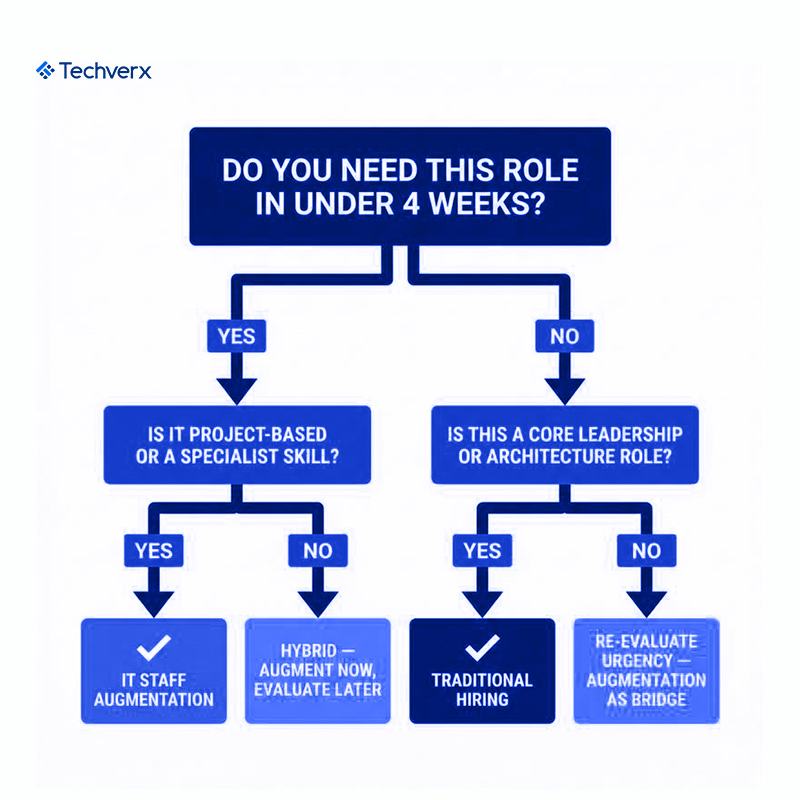
The most effective software team scaling strategies don’t choose between IT staff augmentation and traditional hiring they use each for what it does best.
Core team (traditional hiring): Engineering leadership, senior architects, and engineers embedded in cross-functional product teams requiring deep organizational context. These roles justify the 11-21 week timeline because they compound value over years.
Surge and specialist capacity (IT staff augmentation): Project acceleration when timelines don’t allow traditional hiring cycles, niche skill gaps not worth maintaining full-time, and capacity scaling during peak development phases without inflating permanent headcount.
Companies using this hybrid approach report savings of up to 20% on overall labor costs because they’re not maintaining permanent headcount for work that is inherently temporary or specialized.
What to Look For in a Staff Augmentation Partner
Not all providers deliver equivalent results. When evaluating for your engineering team, assess these factors:
Technical screening depth: Does the provider conduct stack-specific assessments before submission, or simply forward CVs? Shallow vetting eliminates your speed advantage by recreating the same interview overhead you were trying to avoid.
Domain specialization: Providers with vertical expertise in your specific technology stack source senior engineers faster and more accurately than generalist talent agencies.
Replacement guarantees: Reputable providers resolve underperforming augmented engineers in days, not weeks maintaining delivery continuity without the legal complexity of terminating permanent staff.
The Shipping Question Answered
IT staff augmentation vs traditional hiring isn’t a values debate. It’s an operations question about what gets software shipped on schedule.
When teams need to reduce hiring time, close skill gaps in days rather than months, and maintain delivery velocity through headcount changes, IT staff augmentation provides structural advantages that traditional hiring cannot match at speed. When teams need long-term ownership and embedded architectural leadership, traditional hiring produces outcomes worth the extended timeline.
The teams shipping fastest deploy both models deliberately permanent roles where depth compounds over years, augmentation where speed determines whether the release ships.
Techverx provides IT staff augmentation for development teams across the full technology stack, with pre-vetted engineers who integrate quickly and deliver from day one. Contact us to discuss your team’s scaling needs and get matched with engineers ready for your next sprint.
About Techverx
Techverx is a leading AIaaS company specializing in IT staff augmentation, custom development, and technology consulting. We help engineering teams scale faster by providing pre-vetted developers who integrate rapidly into existing workflows and contribute meaningful code from week one. Our staff augmentation services span full-stack development, cloud engineering, data science, and specialized technology domains.

Rachel Kent
Rachel Kent is a Technology Advisor at Techverx based in McKinney, Texas, specializing in digital strategy, scalable architectures, and “right-fit” solutions. With a background as a Software Engineering Lead and full-stack engineer across healthcare and tech, she bridges business goals with modern stacks to rescue stalled projects, modernize legacy systems, and deliver ROI-focused outcomes.
Hiring engineers?
Reduce hiring costs by up to 70% and shorten your recruitment cycle from 40–50 days with Techverx’s team augmentation services.
Related blogs