
Table Of Content
How to Build AI Tools That Patients Actually Use

A bustling clinic waiting room, filled with anxious patients and hurried practitioners, sets the stage for a quiet revolution. Behind the scenes, technology is reshaping healthcare into a more interactive and compassionate experience. AI tools hold the potential to transform patient care, but only if they are crafted with a profound understanding of the users, the patients themselves. The objective is clear: develop technology that seamlessly integrates into patients’ lives and truly makes a difference.
This article delves into the process of conceptualizing, designing, and refining AI tools that genuinely benefit patients while delivering a seamless user experience. From understanding patient needs to balancing automation with the personal human touch, each step presents an opportunity to bridge care and innovation.
Understanding Patient Needs and Behaviors
Before delving into the technical intricacies of AI tool development, it is crucial to comprehend what patients genuinely require. This involves immersing oneself in their world, recognizing their challenges, and acknowledging the barriers that traditional systems may have imposed. Whether a patient is grappling with understanding their complex condition or struggling with appointment scheduling, each interaction can be enriched with the right AI solution.
Recent surveys indicate a significant rise in AI tool integration among clinicians. For instance, a comprehensive survey across 109 countries revealed a near doubling in AI usage among clinicians from 26% to 48% over just one year. This rapid adoption underscores not only the clinical potential but also the importance of designing these tools with end-user patient needs at the forefront.
Conducting Effective User Research with Diverse Patient Populations
Successful design begins with listening. Engaging with a diverse set of patients helps uncover a broad spectrum of requirements and expectations. Interviews, surveys, and direct observations can reveal valuable insights about what patients want from technology. For many, the promise of faster diagnostics or personalized health advice is only as good as the ease with which they can actually use the tool.
- Include voices from varied backgrounds—age groups, socio-economic statuses, and cultural contexts.
- Ensure the final solution is accessible and beneficial for everyone.
- Avoid designing for an assumed “average” user, which might work for some but alienate others.
When every patient sees their needs reflected in the design, trust in the technology increases dramatically.
Identifying Pain Points in Current Healthcare Technology Experiences
Not every technology upgrade equates to an improved patient experience. Patients often express frustration with overly complicated systems, long wait times, and interfaces that are not intuitive. Many traditional healthcare platforms are designed more for administrative convenience than for user satisfaction. Understanding these pain points gives developers a clear directive on what to fix.
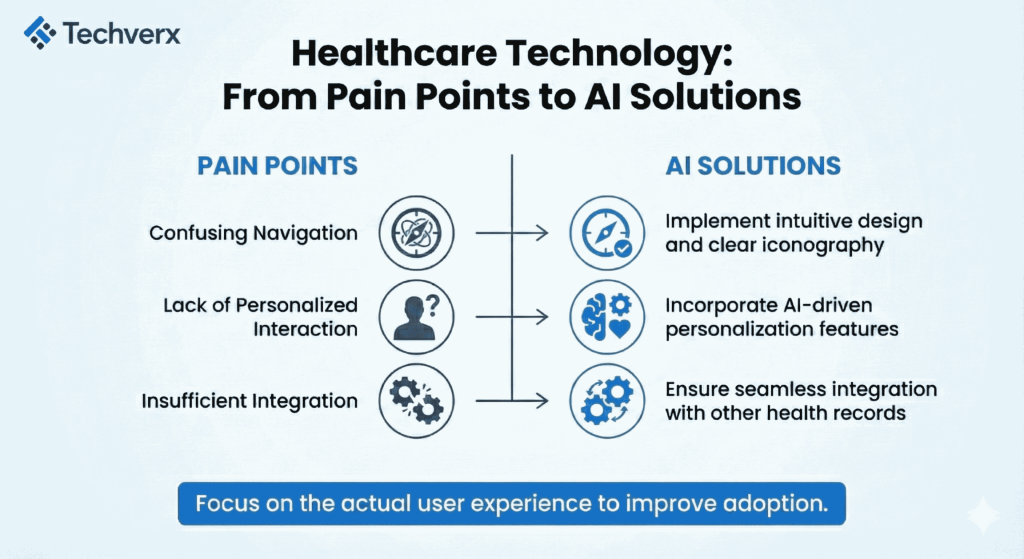
Pain Point | Solution |
Confusing Navigation | Implement intuitive design and clear iconography |
Lack of Personalized Interaction | Incorporate AI-driven personalization features |
Insufficient Integration | Ensure seamless integration with other health records |
By targeting these specific pain areas, AI tools can set themselves apart. When patients feel that technology reduces, rather than adds to, their stress, the adoption rate naturally improves. This focus on the actual user experience is essential, especially when deploying tools across various clinical settings.
Designing AI Tools with Patient-Centered Principles
Designing AI tools for healthcare should extend beyond technical functionality. It also requires a deep commitment to patient-centric principles that prioritize empathy, clarity, and accessibility. This focus not only enhances user experience but also increases overall adoption and engagement among patients.
A major challenge is to create interfaces that feel personal and human while harnessing the power of advanced AI. With physicians increasingly turning to AI solutions, 66% of them reported using health AI in 2024, a notable increase from previous years (American Medical Association) designers have the unique opportunity to learn from both clinician feedback and patient input. The result is a symbiotic system that reinforces trust on both ends of the care spectrum.
Creating Intuitive Interfaces for All Health Literacy Levels
One of the biggest hurdles in healthcare technology is ensuring that digital tools are accessible to every patient, regardless of their familiarity with technology. An intuitive interface is both simple and responsive. It should accommodate patients with varying levels of health literacy, ensuring that no one is left behind.
- Reduce complexity by avoiding unnecessary jargon.
- Use clear iconography and straightforward navigation structures.
- Consider design elements like font size, color contrast, and voice-assisted technologies.
These factors contribute to an overall experience that is inclusive and accessible, thereby enhancing patient autonomy and confidence in managing their own care.
Balancing Automation with Human Connection and Support
Automation can drive efficiency, but in healthcare, human connection remains paramount. Patients often worry that AI tools may depersonalize their care or lead to a loss of empathetic communication. As Greg Samios from Clinical Effectiveness at Wolters Kluwer Health notes, implementation of generative AI in healthcare must consider patient concerns.
Finding the right balance involves offering an automated, data-driven foundation while ensuring that patients have access to real human support when needed. AI should act as an assistant, a digital companion that empowers both patients and clinicians without replacing the essential human touch. This blend makes the technology feel less like a cold machine and more like a helpful tool designed specifically for personal care.
Support systems can be designed within the AI platform, such as real-time messaging with healthcare professionals or scheduled check-ins that provide follow-up care. Such integrations not only simplify complex processes but also foster an environment of trust and reassurance for patients.
Design AI Tools Patients Love Using
From UX design to compliant AI implementation, we help transform ideas into patient-ready digital health solutions that deliver measurable outcomes.
Implementing and Iterating Based on Real-World Use
Rolling out an AI tool is just the beginning. Continuous improvement is vital. Regular testing and feedback ensure that the tool evolves to meet changing patient needs. Real-world use provides insights that laboratory tests or controlled studies might miss.
Implementation should be seen as a dynamic journey rather than a one-time delivery. Clinician feedback is as important as patient feedback. For example, AI-powered medical scribes have shown promising results, but while they are reducing clinician burnout, they have yet to achieve significant improvements in financial outcomes or overall healthcare efficiency.
Establishing Meaningful Metrics for Patient Engagement and Outcomes

Once the AI tool is live, measuring its effectiveness is crucial to ensure that it meets its intended goals. Metrics should not only capture engagement levels but also the quality of interaction and the impact on patient outcomes. Traditional metrics such as click-through rates and usage frequency provide important feedback, as seen in studies where one generated message achieved a notable 12.2% improvement in click-through rates.
- Reduced wait times
- Higher accuracy in diagnostics
- Better adherence to treatment plans
In a healthcare setting where every interaction counts, these metrics help in gauging whether the tool is making a meaningful difference. It is helpful to compare these measurements periodically with baseline data to track improvements and identify areas that need further enhancement.
Developers and healthcare providers should collaborate to create dashboards that compile data from various interactions. This collaborative approach ensures that both clinical and patient perspectives are represented in the improvement process.
Building Continuous Feedback Loops for Ongoing Improvement
The journey to creating truly effective AI tools is ongoing. Continuous feedback loops between patients, clinicians, and developers create a robust process for iterative improvement. When feedback is integrated into the development process, every update reflects real-world usage and addresses emergent needs.
Collecting feedback can include regular surveys, user forums, and direct monitoring of engagement statistics. Modern platforms allow anonymous patient feedback, ensuring that individuals feel safe expressing their opinions. These feedback channels should also extend to healthcare professionals who work directly with the technology.
The cycle of design, test, review, and redesign creates a culture of continuous learning. It builds confidence among patients that their input is valued and that the tool is evolving to improve their care experience. After all, a true patient-centered tool is one that adapts and grows alongside the very people it is meant to serve.
From Innovation to Impact: Making Patient-Centric AI a Reality
Overall, building AI tools that patients actually use requires more than the latest technology. It demands deep attention to user needs, a commitment to accessible design, and a willingness to adapt continuously. By grounding design decisions in real-world research and user feedback, AI tools can effectively bridge the gap between clinical effectiveness and patient satisfaction.
The healthcare industry is witnessing a significant transformation. Over 340 FDA-approved AI tools are currently used for critical diagnostics like strokes, brain tumors, and breast cancer. This momentum is backed by growing clinician and patient acceptance, as well as a notable increase in the use of health AI. With the right mix of technology, empathy, and ongoing engagement, developers can build tools that are not just functional but truly transformative for patient care.
Final Thoughts
Implementing these ideas requires concerted effort from developers, clinicians, and patients alike. When AI tools are designed with patient needs at the core, they have the potential to save hospitals billions, streamline clinical processes, and, most importantly, improve the quality of care. Embracing a patient-centric approach ensures that these tools are not only technically sophisticated but also genuinely supportive, a digital extension of compassionate health care.
Ultimately, the goal is to provide solutions that patients trust and clinicians rely on. This trust is built over time through transparent processes, continuous improvement, and a deep commitment to addressing real-world needs. As the AI in healthcare market gears towards a projected value of $188 billion by 2030, the opportunity to reshape patient care is immense. When technologies are carefully tailored to the patient experience, care becomes more accessible, effective, and humane.
Why do many healthcare AI tools fail to gain patient adoption?
Most fail because they prioritize technology over patient experience, ignoring trust, usability, and emotional needs.
How important is explainability in patient-facing AI?
It’s critical. Patients are more likely to use tools that clearly explain recommendations and decisions.
Can AI replace doctors in patient care?
No. The most effective solutions use AI to support clinicians, not replace them.
How do privacy concerns affect AI adoption?
Strongly. Transparent data practices and compliance significantly increase patient trust and usage.
What role does design play in healthcare AI?
Design directly impacts accessibility, comprehension, and emotional comfort, all of which drive adoption.
How can teams reduce bias in healthcare AI?
By using diverse datasets, conducting regular audits, and applying ethical AI frameworks.

Hannah Bryant
Hannah Bryant is the Strategic Partnerships Manager at Techverx, where she leads initiatives that strengthen relationships with global clients and partners. With over a decade of experience in SaaS and B2B marketing, she drives integrated go-to-market strategies that enhance brand visibility, foster collaboration, and accelerate business growth.
Hiring engineers?
Reduce hiring costs by up to 70% and shorten your recruitment cycle from 40–50 days with Techverx’s team augmentation services.
Related blogs