
Table Of Content
Why Traditional Forecasting Fails in Real-Time Environments (And What Actually Works)

Why Traditional Forecasting Fails in Real-Time Environments
Your production line is running at full capacity. Warehouses are stocked based on last quarter’s numbers. Then overnight, market conditions shift. A competitor launches a flash sale, weather disrupts logistics, or a social media trend changes consumer demand. By the time your team realizes what’s happening, you’re stuck with excess inventory in one region and stockouts in another.
This scenario plays out daily across manufacturing, retail, and logistics. The culprit is not poor planning, but forecasting methods built for a world that no longer exists.
A staggering 76% of manufacturers acknowledge that traditional forecasting is obsolete. Yet 95% still rely on manual techniques and spreadsheet-based predictions. The result is predictable: only 7% of companies achieve forecast accuracy above 90%, while most hover between 70–79%, leaving massive value on the table.
Real-time environments demand real-time intelligence. Traditional forecasting cannot deliver it. Here’s why it fails and what actually works.
The Core Limitations of Traditional Forecasting Models
Assumption of Historical Continuity
Traditional forecasting models are built on a dangerous assumption: the future will resemble the past. Time-series methods such as ARIMA, exponential smoothing, and moving averages analyze historical sales data, identify trends, and project them forward.
This approach worked when markets were stable. Today’s business environment is anything but stable. Pandemic-driven demand shifts, supply chain disruptions, viral consumer trends, and sudden economic changes have destroyed the predictive power of historical data.
When COVID-19 hit, demand for home fitness equipment surged almost overnight, while office furniture demand collapsed. Historical data became irrelevant. Organizations relying on traditional forecasting faced massive overstock or severe shortages.
Inability to Account for External Demand Drivers
Manual, Slow, and Error-Prone Forecasting Processes
Legacy forecasting systems focus almost entirely on internal data while ignoring the external forces that actually drive demand. Factors such as weather patterns, economic indicators, competitor pricing, social media sentiment, geopolitical events, and logistics disruptions are invisible to traditional models.
A retailer forecasting winter coat demand based only on past sales may completely miss the impact of an unusually warm winter. A manufacturer planning production without tracking raw material price volatility risks sudden margin erosion.
Research shows that incorporating external data sources can improve forecast accuracy by 20–40%, something traditional forecasting systems are not designed to handle.
Despite advances in enterprise systems, much of forecasting still happens in spreadsheets. Analysts manually pull data from multiple sources, clean it, apply formulas, adjust assumptions, and circulate reports.
This process often takes days or weeks, during which market conditions continue to evolve. Manual workflows also introduce human error at every stage, from data entry mistakes to broken formulas and subjective bias.
One FMCG logistics company spent over £350,000 annually on demand planning resources and still lost £5 million in excess and obsolete inventory due to forecast inaccuracies.
Poor Scalability and Lack of Granularity
Modern businesses operate across thousands of SKUs, multiple channels, and hundreds of locations. Accurate forecasting now requires predictions at the SKU–store–day level.
Traditional statistical models struggle to scale at this level. As a result, organizations forecast at high-level aggregates such as category, month, or region. These averages hide local demand variations, leading to persistent stockouts in some locations and overstock in others.
A retailer with 10,000 SKUs across 500 stores would need millions of individual forecasts per day, a task traditional methods simply cannot handle efficiently.
Organizational Silos and Fragmented Data
Forecast accuracy also suffers from internal silos. Sales, marketing, supply chain, and finance teams often operate with separate data systems and conflicting assumptions.
Sales forecasts growth, supply chain plans conservatively, and finance budgets cautiously. The result is misalignment across the organization. McKinsey research shows that siloed forecasting can increase operational costs by 15–20% through redundant safety stock and inefficient planning.
Why Real-Time Business Environments Require Real-Time Forecasting
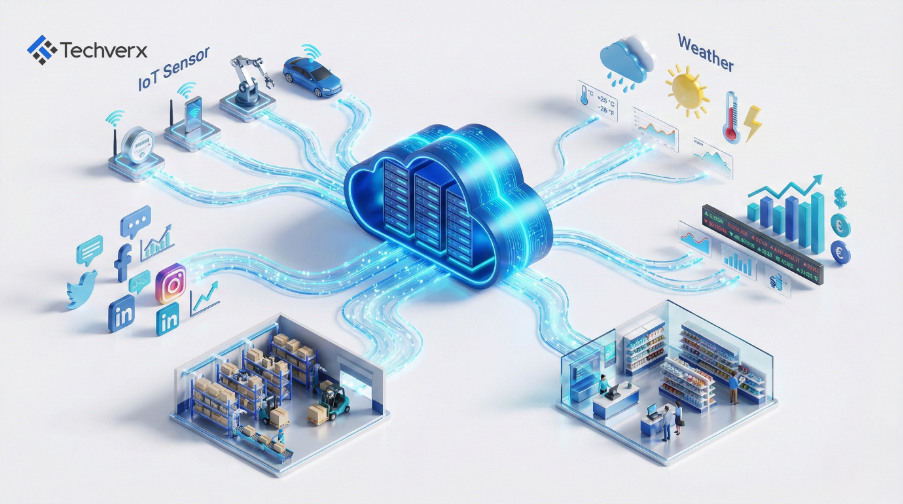
Customer demand now shifts in real time, driven by weather changes, social trends, competitor actions, and market volatility. Supply chains span continents and can be disrupted instantly.
Traditional forecasts updated monthly or quarterly operate on a completely different timeline than modern business reality. By the time a forecast is finalized and distributed, it is often already outdated.
Real-time environments require forecasting systems that continuously adapt, learn, and update as new data arrives.
How AI-Powered Forecasting Solves These Challenges

Multi-Variable Forecasting at Scale
AI-powered forecasting systems ingest and analyze data from dozens of sources simultaneously. This includes historical sales, pricing changes, promotions, weather forecasts, economic indicators, social media sentiment, competitor activity, and supplier performance.
Machine learning models uncover complex, non-linear relationships between variables that traditional models and human analysts cannot detect. Organizations using AI forecasting report 30–50% reductions in forecast error compared to legacy approaches.
Continuous Learning and Self-Improving Models
Unlike static statistical models, AI systems continuously learn. As real demand data comes in, predictions are automatically compared to actual outcomes, and models adjust themselves to improve future accuracy.
This adaptive learning is critical in volatile markets. One manufacturing company reduced forecast error from 25% to under 10% within six months after implementing AI-driven demand forecasting.
Granular SKU-Level Demand Forecasting
AI excels at producing highly granular forecasts across massive datasets. Businesses can forecast demand at the SKU, store, and day level across all channels and regions.
This precision enables better inventory placement, reduced carrying costs, and improved product availability without relying on excess safety stock.
Real-Time Scenario Planning and Simulation
AI forecasting platforms also enable real-time scenario modeling. Businesses can instantly assess how demand would change if raw material prices spike, a competitor launches a promotion, or weather patterns shift.
This transforms forecasting from reactive reporting into proactive decision-making.
Measurable Business Impact of AI Forecasting
Organizations that transition from traditional to AI-powered forecasting see consistent results:
- Cost Reduction: Up to 30% lower operational costs through optimized inventory and reduced expedited shipping
- Inventory Optimization: 20–40% reduction in carrying costs while improving service levels
- Revenue Growth: 10–15% increase in revenue due to fewer stockouts
- Operational Agility: Faster response to disruptions, often within hours instead of weeks
McKinsey research also shows that AI can reduce supply chain planning time by up to 50%.
See How AI Forecasting Works in Real Time
Explore how machine learning models continuously learn, adapt, and deliver accurate predictions.
How to Transition from Traditional Forecasting to AI
Adopting AI forecasting does not require replacing existing ERP or planning systems. Modern AI platforms integrate with legacy infrastructure.
Best practices include:
- Start with high-impact product categories or regions
- Unify internal and external data sources
- Invest in change management and analyst upskilling
- Choose scalable platforms that grow with your business
The Cost of Sticking with Traditional Forecasting
Every day spent relying on traditional forecasting is a day of lost revenue, excess inventory costs, and competitive disadvantage. While 76% of manufacturers acknowledge their forecasting is obsolete, those who act decisively gain measurable advantages over those who delay.
The question isn’t whether AI-powered forecasting works the evidence is overwhelming. The question is how quickly you can implement it before competitors do.
Real-time environments demand real-time intelligence. Traditional forecasting can’t deliver it. AI can.
Ready to transform your forecasting from reactive guesswork to proactive intelligence?
Techverx specializes in AI-powered forecasting solutions that deliver measurable accuracy improvements and ROI within months.
Schedule a consultation to discover how AI forecasting can eliminate the limitations holding your business back.
FAQ’S
Why does traditional forecasting fail in real-time environments?
Traditional forecasting depends on historical data and periodic updates, which makes it slow to react to sudden demand shifts, disruptions, or behavioral changes happening in real time.
What are the biggest limitations of traditional forecasting models?
They struggle with static assumptions, linear patterns, and delayed data refresh cycles, making them ineffective in fast-moving, data-rich environments.
Can traditional forecasting handle volatile or unpredictable demand?
No. Traditional models perform poorly when demand fluctuates due to promotions, seasonality changes, supply chain disruptions, or external market forces.
How does real-time data change forecasting accuracy?
Real-time data enables continuous model updates, allowing forecasts to adapt instantly to new signals such as sales spikes, inventory changes, or customer behavior.
What forecasting approach works best in real-time environments?
AI-driven and machine learning–based forecasting works best because it processes live data streams, identifies complex patterns, and adjusts predictions dynamically.
Is AI forecasting replacing traditional forecasting completely?
Not entirely. AI enhances forecasting by complementing traditional methods with adaptive intelligence, speed, and predictive accuracy for modern operations.

Hannah Bryant
Hannah Bryant is the Strategic Partnerships Manager at Techverx, where she leads initiatives that strengthen relationships with global clients and partners. With over a decade of experience in SaaS and B2B marketing, she drives integrated go-to-market strategies that enhance brand visibility, foster collaboration, and accelerate business growth.
Hiring engineers?
Reduce hiring costs by up to 70% and shorten your recruitment cycle from 40–50 days with Techverx’s team augmentation services.
Related blogs