Table Of Content
AI-Powered Customer Engagement for B2B SaaS: Transforming Service into Revenue

For B2B SaaS companies, customer engagement isn’t just about satisfaction, it’s directly tied to net revenue retention, expansion opportunities, and long-term viability. Engaged customers renew contracts, expand their usage, and become advocates. Disengaged customers churn.
The challenge? Your customers expect enterprise-grade support with consumer-grade speed. They want immediate answers to complex technical questions, proactive guidance on feature adoption, and seamless experiences across every touchpoint, from in-app messaging to support tickets to community forums.
Traditional scaling approaches won’t work. Adding more customer success managers and support engineers drives costs up faster than revenue. The average B2B SaaS company already spends 15-20% of revenue on customer support and success operations, yet response times and satisfaction scores continue to decline as customer bases grow.
AI-powered customer engagement offers a different path. Companies that successfully implement AI-enabled customer service see measurable improvements: reduced time-to-resolution, higher customer satisfaction scores, increased product adoption, and expansion revenue growth, all while controlling costs.
According to recent industry research, AI technologies in customer service could unlock significant value across B2B sectors. Organizations implementing conversational AI and intelligent automation report handling 60-80% of routine inquiries without human intervention, freeing customer success teams to focus on strategic accounts and complex problem-solving.
Yet most B2B SaaS companies are still in early stages. While digital-native platforms like Slack, Notion, and Intercom have reached advanced maturity in AI-driven engagement, many enterprise SaaS providers struggle with fragmented systems, inconsistent customer data, and resistance to automation.
Three Critical Challenges Blocking AI Adoption
First challenge: Increasing complexity
The shift to self-service has created a paradox. As customers successfully handle routine tasks through knowledge bases and automated workflows, support teams now face only the most complex, nuanced issues. A customer reaching out about API integration failures, SSO configuration, or enterprise security requirements needs sophisticated help, not a basic chatbot response.
Second challenge: Rising expectations
B2B buyers increasingly expect consumer-grade experiences. If they can get instant answers from ChatGPT or immediate shipping updates from Amazon, they expect the same responsiveness from their $50K/year enterprise software provider. Customers now expect real-time answers to technical questions, proactive alerts about performance issues, and personalized guidance based on their usage patterns.
Third challenge: Talent scarcity
Finding experienced customer success professionals who understand both your product and your customers’ business problems is increasingly difficult. The competition for technical support talent is intense, turnover is high, and training new hires takes months. AI offers a way to augment existing teams and preserve institutional knowledge, but implementing it requires AI/ML expertise that’s equally scarce.
The Maturity Framework: Five Levels of AI-Powered Engagement
Leading B2B SaaS companies progress through five distinct maturity levels in their journey toward AI-enabled customer engagement.
Level 1 represents traditional manual service. Support tickets are handled individually by humans, knowledge is scattered across email threads and Slack channels, and every customer question requires human attention. This approach doesn’t scale.
Level 2 introduces basic automation and knowledge bases. Companies implement help center articles, simple chatbots for FAQs, and email templates. Resolution times improve slightly, but most complex issues still require significant manual effort.
Level 3 brings intelligent routing and assisted responses. AI systems analyze incoming requests, route them to appropriate specialists, and surface relevant knowledge to agents in real-time. Customer success platforms like Gainsight or ChurnZero begin automating health scoring and identifying at-risk accounts.
Level 4 features advanced AI-powered self-service and proactive engagement. Conversational AI handles sophisticated queries, pulling from product documentation, past tickets, and usage data. The system proactively identifies struggling users and triggers interventions before problems escalate. In-app guidance adapts to user behavior patterns.
Level 5 represents fully intelligent, predictive engagement. AI systems anticipate customer needs based on usage patterns, industry trends, and similar customer journeys. They automatically optimize onboarding flows, suggest relevant features, flag expansion opportunities, and predict churn risk with high accuracy. More than 90% of routine interactions happen through AI-powered channels, while human experts focus exclusively on strategic relationships and complex problem-solving.
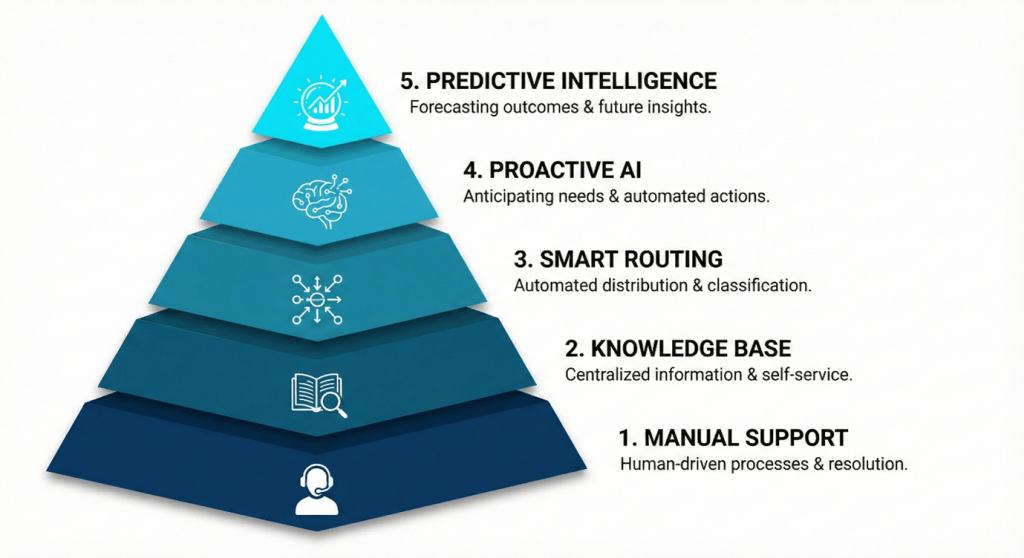
Most B2B SaaS companies today operate between levels 2 and 3. Digital-native platforms like Figma, Airtable, and Linear are pushing toward level 4. Few have reached level 5, but the competitive advantage is clear, these companies maintain high customer satisfaction while operating with significantly lower customer support costs per user.
Building AI-Powered Engagement Across the Customer Lifecycle
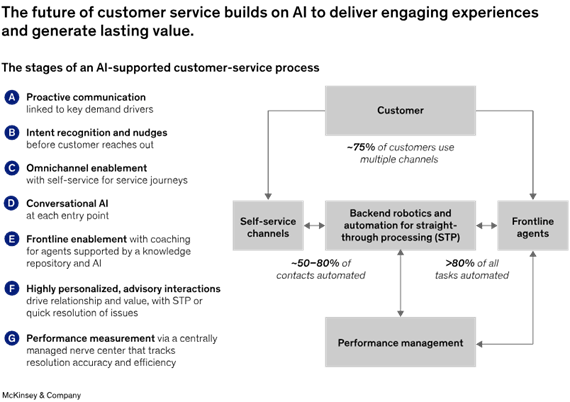
Successful AI implementation requires a systematic approach across all customer touchpoints:
Before customers engage, AI systems analyze usage patterns, identify potential issues, and trigger proactive outreach. If a customer’s API call volume suddenly drops, or if they haven’t logged in for days after onboarding, automated workflows can reach out with targeted help before frustration builds.
During active engagement, conversational AI handles routine questions while intelligently escalating complex issues. The system pulls context from usage data, previous tickets, and product documentation to provide accurate, relevant answers. For technical questions requiring human expertise, AI assists support engineers by surfacing relevant information and suggesting solutions based on similar past cases.
After resolution, AI analyzes interaction patterns to identify knowledge gaps, optimize documentation, and predict future issues. Machine learning models continuously improve response accuracy by learning from successful resolutions.
This approach requires integration across your tech stack, your product analytics, CRM, support platform, and communication tools must share data to enable truly intelligent engagement.
The Human Element in AI-Powered Customer Success
AI-powered doesn’t mean human-free. The most successful implementations use AI to augment human expertise, not replace it.
Smart systems handle repetitive tasks, password resets, billing questions, feature explanations—freeing customer success managers to focus on strategic work: guiding enterprise implementations, conducting quarterly business reviews, identifying expansion opportunities, and building executive relationships.
Even before a customer submits a ticket, AI systems can flag concerns to customer success managers. If usage patterns suggest a customer is struggling with a specific feature, or if sentiment analysis of in-app messages indicates frustration, your team can reach out proactively, turning potential churn situations into opportunities to demonstrate value.
When customers do reach out, AI assists human agents in real-time. As a support engineer works on a complex technical issue, the AI system surfaces relevant documentation, suggests troubleshooting steps based on similar past cases, and even recommends which internal experts to consult. This preserves institutional knowledge and makes every team member more effective.
Measurable Impact on SaaS Business Metrics
Organizations implementing AI-powered customer engagement see tangible results across key SaaS metrics:
Research from leading SaaS companies indicates that AI customer service implementations can improve operational effectiveness by 40-60%, with specific improvements including:
- 56% report improved operational efficiency through automated ticket routing and self-service resolution
- 68% see measurable customer satisfaction increases from faster response times and consistent service quality
- 61% achieve higher team productivity by eliminating repetitive tasks and augmenting expertise
- 70-80% reduction in routine ticket volume through intelligent self-service and proactive engagement
More importantly, these operational improvements translate to business outcomes. Companies report improved net revenue retention rates, reduced customer acquisition cost payback periods, and increased expansion revenue as customer success teams shift from reactive support to strategic relationship management.
Getting Started: A Practical Implementation Path
Most B2B SaaS companies face similar obstacles: legacy systems, fragmented customer data, limited AI expertise, and organizational resistance to automation. Success requires a methodical approach.
Start with stakeholder alignment. Customer success, product, engineering, and data teams must coordinate. Early involvement reduces resistance and ensures the AI system gets access to the data and integrations it needs.
Begin with high-volume, low-complexity use cases. Automating password resets, billing questions, or basic feature explanations delivers quick wins and builds confidence. These successes create momentum for tackling more complex scenarios.
Invest in data infrastructure. AI systems are only as good as the data they can access. Unify customer data across your CRM, product analytics, support platform, and communication tools. Ensure data quality through regular auditing and cleanup processes.
Choose scalable, integrated solutions. Avoid point solutions that create new silos. Look for platforms that integrate with your existing tech stack and can grow with your needs. Consider whether to build custom AI models, use third-party platforms like Intercom or Zendesk with AI features, or combine both approaches.
Establish clear metrics and iterate rapidly. Define success criteria upfront—whether that’s first-response time, resolution rate, CSAT scores, or cost per ticket. Monitor these metrics closely and continuously refine your AI models and automation rules based on real performance data.
Prioritize data privacy and security. B2B customers trust you with sensitive business data. Ensure your AI implementation maintains enterprise-grade security standards and complies with relevant regulations. Create transparent data policies that build customer trust rather than erode it.
The Competitive Imperative
AI-powered customer engagement isn’t a future consideration, it’s a current competitive differentiator. As customer expectations continue rising and talent becomes scarcer, companies that effectively leverage AI will operate with better unit economics while delivering superior customer experiences.
The companies winning in B2B SaaS today understand that customer service is no longer a cost center to minimize, it’s a revenue driver to optimize. AI makes this optimization possible by combining the efficiency of automation with the expertise of human specialists.
The question isn’t whether to implement AI-powered customer engagement, but how quickly you can execute effectively. Your customers already expect it. Your competitors are building it. The time to start is now.
Ready to transform your customer engagement with AI?
TechVerx specializes in building intelligent customer service systems for B2B SaaS companies. From conversational AI to predictive analytics, we help you deliver exceptional experiences at scale.
Schedule a consultation to explore how AI can transform your customer success operations.

Rachel Kent
Rachel Kent is a Technology Advisor at Techverx based in McKinney, Texas, specializing in digital strategy, scalable architectures, and “right-fit” solutions. With a background as a Software Engineering Lead and full-stack engineer across healthcare and tech, she bridges business goals with modern stacks to rescue stalled projects, modernize legacy systems, and deliver ROI-focused outcomes.
Hiring engineers?
Reduce hiring costs by up to 70% and shorten your recruitment cycle from 40–50 days with Techverx’s team augmentation services.
Related blogs