Managed Delivery Pods vs Staff Augmentation: What’s Replacing It in 2026?
Staff augmentation was a good answer to the wrong question.
The question most engineering leaders asked was: how do we get more developers? Staff augmentation answered that perfectly. Hire fast, skip payroll overhead, scale headcount up or down, plug external talent directly into your existing team and ceremonies. For years, it worked well enough.
But the question that actually matters is different: how do we ship better software, faster, with less management burden? And on that question, staff augmentation consistently underdelivers. That is why a structural shift is happening across product engineering right now, away from individual contractor models and toward managed software delivery pods that own outcomes rather than log hours.
The IT outsourcing market is projected to hit $812.71 billion by 2029 at an 8.28% CAGR, according to Statista. The growth is real. But the way that growth is being captured is changing. The companies pulling ahead are not just buying more developer time. They are buying delivery accountability.
The Staff Augmentation Trap
Staff augmentation sounds great on paper, just bring in more engineers and move faster. But in reality, it usually does the opposite. Every new developer needs onboarding, context, and constant alignment, which means your senior team stops building and starts managing. Instead of speeding things up, you end up adding more communication, more back-and-forth, and more chances for things to slip. The real problem is you’re still owning delivery, just with extra overhead. So while it helps you fill positions quickly, it doesn’t guarantee you’ll actually ship faster, and that’s where most teams get stuck.
💡 The Faros AI Finding
Faros AI’s July 2025 analysis of over 10,000 developers found what it called the ‘AI Productivity Paradox’: AI coding assistants boosted individual output by 21% more tasks completed and 98% more pull requests merged, but organizational delivery metrics stayed flat. Adding more capacity (human or AI) without fixing the delivery system doesn’t move the needle on outcomes.
What a Managed Software Delivery Pod Actually Is
A managed delivery pod is a small, cross-functional, self-contained software team, typically 3 to 8 people, that owns a defined product area or delivery objective end-to-end. The pod includes developers, QA engineers, a DevOps or platform engineer, and a delivery lead, under a single contracted arrangement with a fixed monthly fee.
The critical distinction is not the team composition. It is the ownership model.
In a staff augmentation arrangement, your company owns the delivery. In a managed pod arrangement, the pod owns the delivery. The pod is accountable for cycle time, deployment frequency, defect rates, and the business outcomes tied to the product area it runs. Your engineering leaders stop managing external headcount and start reviewing delivery telemetry.
This maps directly to how the 2025 DORA State of AI-Assisted Software Development Report describes high-performing team archetypes: teams that achieve what DORA calls ‘Harmonious High-Achiever’ status are characterized by shared ownership of outcomes, not just individual contribution to tasks. The pod model is structurally designed to produce exactly this pattern.
Techverx’s managed delivery pods are built around this ownership-first model. See how our custom software development teams are scoped, staffed, and held accountable for delivery outcomes from sprint one.
Staff Augmentation vs Managed Delivery Pod: Side by Side
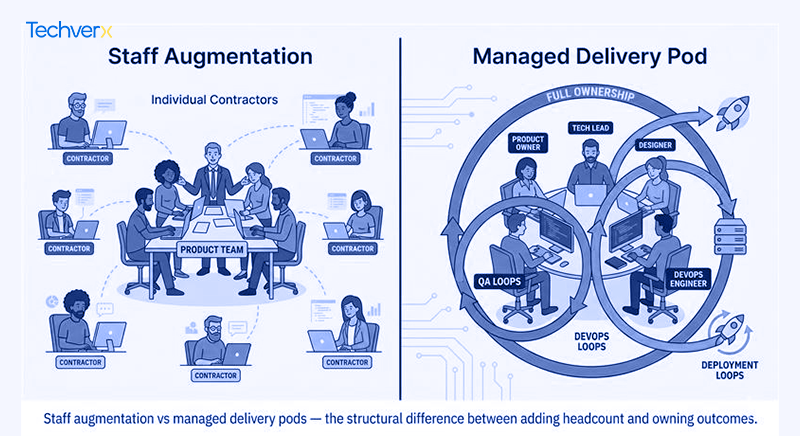
| Staff Augmentation | Managed Delivery Pod | |
|---|---|---|
| Who manages the work? | You do | The pod does |
| Who owns quality? | You (client-side QA) | Pod owns QA, testing, code review |
| Team composition | Individual contractors | Cross-functional: dev, QA, DevOps, PM |
| Accountability | Hours and availability | Outcomes, cycle time, DORA metrics |
| Onboarding time | Weeks, per hire | One structured transition (days) |
| Pricing model | Per-head hourly or monthly | Single monthly fee per pod |
| Legal/compliance risk | High (IR35, IRS, EU contractor rules) | Low (clear MSA boundaries) |
| Scales how? | Add more individuals | Adjust pod size or add a pod |
| Knowledge retention | Leaves with the contractor | Stays in pod processes and docs |
| Best for | Filling a specific skill gap fast | Owning a product area end-to-end |
Why Delivery Pods Are Winning
They come with quality baked in, not bolted on
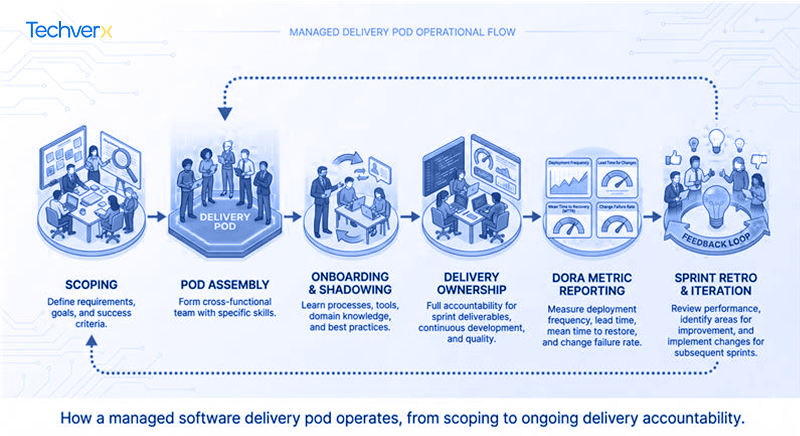
In a staff augmentation model, QA is your responsibility. Code reviews are your responsibility. CI/CD pipeline health is your responsibility. In a managed pod, every one of those functions is built into the team’s operating structure. The pod ships with automated testing, defined code review standards, deployment pipelines, and incident response runbooks. Quality is not a separate workstream. It is how the team operates by default.
They track outcomes, not hours
Staff augmentation bills by the hour or the head. A managed pod is contracted against deliverables and performance metrics: deployment frequency, change lead time, defect leakage rate. The 2025 DORA framework explicitly tracks these dimensions as the primary signals of software delivery health. When your vendor’s commercial incentive is aligned with your delivery outcomes rather than hours logged, the relationship is structurally different. Problems get surfaced early. Performance issues get fixed by the pod, not escalated to you.
They eliminate the revolving door of context loss
One of the most expensive hidden costs of staff augmentation is institutional knowledge that leaves with the contractor. Every rotation cycle means re-onboarding, re-documenting, and re-building the context that the outgoing engineer accumulated. Managed pods are designed for continuity. Documentation, architecture decisions, runbooks, and tribal knowledge live in pod processes, not in individual contractors’ heads. The pod absorbs transitions without leaking the institutional memory that makes delivery possible.
This is especially critical for AI-driven products and integrations, where model context, prompt design, and inference infrastructure are highly specialized. Techverx’s AI and machine learning delivery teams operate as managed pods with full continuity of model and data context across the engagement.
They scale without multiplying your management surface area
Scaling a staff augmentation model means adding more people, each of whom needs onboarding, management, and context. Scaling a pod model means either expanding an existing pod or spinning up a second one, each with its own defined scope and accountability. The management overhead scales proportionally to pods, not to individual headcount. A company running three delivery pods has three delivery accountability points, not 15 individual contractor relationships to manage.
They come with cleaner commercial and legal terms
Managed pods operate under a Master Service Agreement with a fixed monthly fee and defined SLAs. There is no per-head, per-hour, or per-feature billing complexity. And critically, the IR35, IRS, and EU contractor compliance risks that come with long-term augmentation engagements are dramatically reduced. The pod is a vendor relationship, not an employment-adjacent arrangement. That distinction protects organizations from the tax and legal exposure that long-running augmentation contracts increasingly attract.
When Staff Augmentation Still Makes Sense
This is not an argument that staff augmentation has no place. It does. But it is a narrower place than most companies currently use it for.
Staff augmentation is the right model when you need a very specific technical skill for a defined, short period, a niche security engineer for a compliance audit, a React Native specialist to get a mobile feature across the line, a data engineer to build a one-time migration pipeline. Engagements where the scope is bounded, the duration is genuinely short (under six months), and your internal team is strong enough to absorb and manage the additional capacity.
For anything longer, anything architecturally complex, or anything where you need delivery accountability rather than delivery capacity, the pod model is structurally better. Many organizations are converging on a hybrid: staff augmentation for specific, time-boxed skill gaps and managed pods for the product areas that need sustained, outcome-accountable delivery ownership.
Techverx offers both models and can help you figure out which is the right fit for each part of your product. Explore our IT and software delivery engagement models to see how the options are structured.
How to Make the Switch: Practical Starting Points
If you are currently running augmented teams and considering a move to managed pods, a few things make the transition significantly smoother.
- Start with a pilot pod on one defined product area. Pick something real but bounded, a specific service, a feature track, a platform component. Give the pod three sprints with clear KPIs and compare delivery telemetry against your augmented team benchmarks.
- Define the ‘surface area’ of ownership explicitly. What services, user journeys, or integrations does the pod own? Vague ownership produces vague accountability. The more precisely you define the domain, the more precise the pod’s delivery contract can be.
- Set DORA metrics as baseline contract terms. Deployment frequency, change lead time, and defect leakage rate should be in the SOW, not just aspirational. This is what separates a vendor relationship from a delivery partnership.
- Plan the knowledge transfer phase properly. Good pod providers run a structured shadowing and reverse-shadowing process before full ownership transfer. The pod observes, then runs ‘safe first’ deployments while your team watches, then takes full ownership with fallback checkpoints. Skip this and you are accepting unnecessary transition risk.
If you are ready to have a concrete conversation about how this would work for your specific product, the Techverx team can walk you through what a pilot pod scope would look like, the commercial structure, and what KPIs to baseline against.
Currently Running Augmented Teams? Let’s Talk.
Techverx helps engineering leaders evaluate whether a managed pod model is the right fit for their delivery challenges, with no pressure to switch until the case is clear.
→ Book a Free Engagement Model Consultation
The Bottom Line
Staff augmentation is not going away. But its role is narrowing to what it was always best at: filling specific, time-bounded skill gaps with external talent your team manages directly. For everything else, sustained product delivery, complex platform ownership, AI-driven systems, long-running engineering programs, the managed delivery pod model is structurally superior in every dimension that actually determines engineering outcomes.
The companies making this shift are not doing it because it is trendy. They are doing it because their engineering leaders got tired of managing contractors instead of products, their QA kept shipping inconsistently, and their knowledge base kept walking out the door at the end of every contract.
Delivery accountability is the product. The pod is how you buy it.
If you want to explore what a managed delivery pod engagement looks like for your specific situation, the Techverx team is ready to have that conversation.